
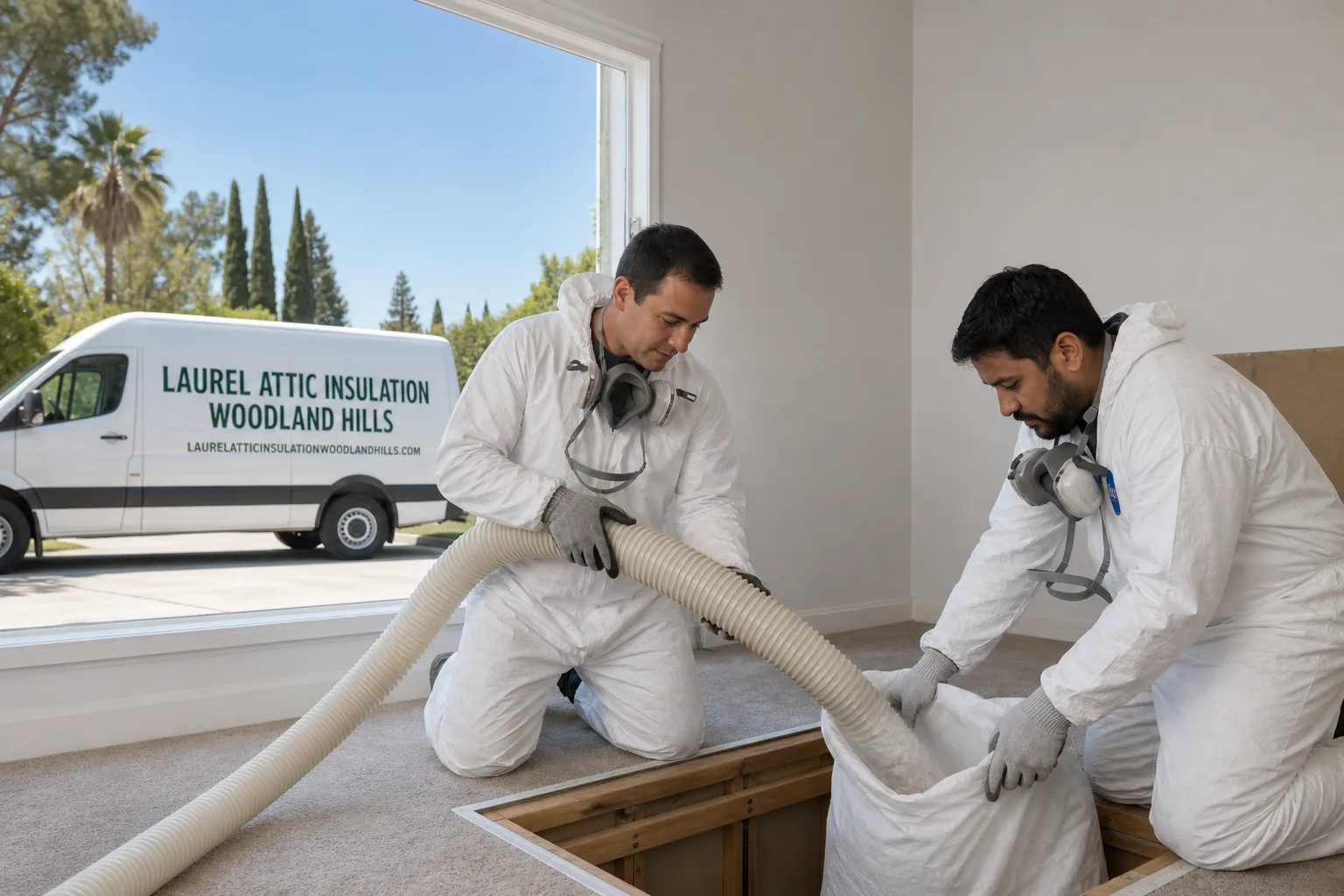
Fast, Reliable Spray Foam Insulation Across Woodland Hills
Spray foam insulation in Woodland Hills typically costs $2,400 – $6,800 for a full attic application, and most jobs take one to two days. That’s the honest range you’ll see from us before a single gallon of foam is mixed. We work the mid-century ranch neighborhoods south of Ventura Boulevard and up into the Topanga foothills every week, and our crews know exactly what these 1950s-70s homes need when the Valley heat hits 105°F. Call (559) 295-5362 and you’ll get a live person, a real arrival time, and a written price before anything starts.
Why Laurel Attic Insulation Woodland Hills Is Woodland Hills’s Preferred Spray Foam Insulation Company
The homes here aren’t like the new builds in Porter Ranch or the condos in Warner Center. Woodland Hills is mostly stucco ranch houses with flat or barely-sloped roofs, wood framing, and attic spaces that were never designed for modern insulation loads. Our technicians have crawled through hundreds of these attics, from the El Camino School district north to the Hidden Hills border. We know where the rafter tails pull away, where the original foil-faced sheathing hides moisture, and where the foam needs an extra half-inch to make the R-value real.
Every Woodland Hills job runs on the Relay Visibility Guarantee. You book, you get a live arrival time, and you see before-and-after photos of the foam before you pay from a link. No vague four-hour windows. No “the guys will call when they’re close.” Chase Whitaker, who runs our Woodland Hills operation, insists that a homeowner should never wonder whether the crew actually applied what the quote promised. That’s why every job also comes with the 365-Day Done Right Promise in writing. If it isn’t right, we make it right. No charge, no argument, and a free second visit if the repair fails.
Rim Joist Spray Foam in Woodland Hills
Rim joist spray foam is one of the first fixes we recommend for Woodland Hills homes built before 1980, because those rim joists are usually uninsulated and leak conditioned air straight into the crawl space or garage. The rim joist is the band of wood that runs around the perimeter of your house, where the floor framing meets the foundation. On a stucco ranch, that seam pulls outside air whenever the wind pushes against it. Sealing it with closed-cell foam stops that air movement cold. In Woodland Hills, rim joist spray foam usually runs $400 – $900 for a standard single-story perimeter, depending on access and how many penetrations need sealing.
Why 1950s-70s Ranchers Have Worse Rim Joist Leaks
Those homes were framed with lumber that’s now sixty to seventy years old. The wood has dried and shrunk, opening gaps between the mudsill and the first-floor deck. Air moves through those gaps freely, which is why the floor above a crawl space feels ten degrees colder in January.
Closed-cell foam expands into those gaps and hardens, creating an air seal and a moisture barrier at the same time. It also adds R-6 to R-7 per inch, which is more than enough to turn a drafty perimeter into a stable thermal boundary.
When to Do Rim Joist Foam Before Attic Work
If you’re planning a full attic insulation upgrade, do the rim joists first. The stack effect pulls air up through the house from the crawl space, and if the perimeter leaks, all that new attic insulation is fighting a draft. Sealing the bottom of the thermal envelope makes the top work better.
Crawl Space Spray Foam Insulation in Woodland Hills
Crawl space spray foam insulation in Woodland Hills works because our winters are damp enough to make an unsealed crawl space musty, and our summers are hot enough that the same damp air degrades fiberglass batts within three to five years. Spraying closed-cell foam on the crawl space walls, rather than stuffing batts between floor joists, treats the crawl space as part of the conditioned envelope. That’s the modern approach, and it stops both moisture and heat from moving through the floor assembly. A typical crawl space encapsulation with spray foam in Woodland Hills runs $3,000 – $6,500, depending on square footage, ceiling height, and whether a vapor barrier is already in place.
Vented Crawl Spaces In Mid-Century Homes
Most Woodland Hills ranch homes have vented crawl spaces with small screened openings around the foundation. Those vents let humid winter air in, and the moisture condenses on cool floor joists. Over decades, that’s how you get sagging subfloor and musty smells that creep up through the registers.
Closed-cell foam on the foundation walls, combined with a sealed vapor barrier, keeps the humidity out and the indoor air where it belongs. The foam also stiffens the foundation walls, which matters on older block or concrete foundations that have settled with the valley’s expansive clay soil.
What Old Crawl Spaces Reveal Before the Work Starts
Before we spray, we check for rodent access points and old termite damage. A crawl space that hasn’t been touched since 1962 will have both. Foam seals the entry points, but we address anything structural before the foam goes on so you’re not covering up a problem that gets worse silently.
Trusted Brands We Service in Woodland Hills
We work with eight manufacturer brands, and for Woodland Hills jobs we commonly spec Owens Corning and Johns Manville closed-cell products for rim joists and crawl spaces, plus Knauf open-cell foam for attic roof decks where the roof pitch allows ventilation. The materials are never whatever happens to be on the truck. We match the foam’s expansion rate and density to your home’s framing, sheathing type, and your specific moisture conditions. Because we stock local parts and material options for the Woodland Hills market, turnaround on reorders is the same day in most cases, not the three to five days a supplier from outside the Valley would need.
Common Spray Foam Insulation Problems We See in Woodland Hills Homes
- Foam shrinkage at old rafter tails. Sixty-year-old framing settles, and when closed-cell foam is applied tight to the rafter tails, any movement opens hairline gaps. We see this most on homes south of Ventura Boulevard where the daily summer heat cycle is extreme. The fix is an extra pass of foam at the eaves and proper vent baffling before the roof deck is sprayed.
- Condensation traps over original foil-faced sheathing. Some 1960s Woodland Hills homes have fiberboard sheathing with a foil face. Closed-cell foam applied directly over it without a proper moisture analysis traps condensation between the foam and the foil. The sheathing rots from the inside. We inspect the sheathing type before quoting, every single time.
- Open-cell foam wicking winter humidity in vented attics. Open-cell foam is air-permeable, which makes it great for sound but risky in a low-slope vented attic during a wet Woodland Hills winter. If the attic isn’t properly sealed and ventilated, the foam absorbs moisture and the drywall below stains. We spec closed-cell or add a ventilation upgrade in these situations.
- Valley Fever exposure during old insulation removal. Before any spray foam goes in, the old insulation comes out, and many Woodland Hills attics carry decades of rodent droppings and dust. Valley Fever spores live in that dust. Our crews wear proper respiratory protection and we schedule attic work for early morning in summer when attic temperatures are still survivable.
Pricing for Spray Foam Insulation in Woodland Hills, CA
Open-cell spray foam on an attic roof deck in Woodland Hills runs $2,400 – $4,800 for a typical 1,200 to 1,800 square foot ranch. Closed-cell foam, which gives you a vapor barrier plus higher R-value per inch, runs $3,800 – $6,800 for the same footprint. Rim joist sealing is $400 – $900. Crawl space encapsulation with spray foam starts around $3,000 and tops out near $6,500 for larger footprint homes. The price is set after we measure the actual surfaces and check access, sheathing type, and whether any old insulation needs removal first. Every quote is written, delivered before work starts, and backed by the 365-Day Done Right Promise. Call (559) 295-5362 for a free estimate.
We Also Serve Cities Near Woodland Hills
Our crews cover Woodland Hills and the surrounding Valley communities, including Canoga Park, Topanga, Tarzana, and West Hills. If you’re in any of those neighborhoods and looking for Spray Foam Insulation, you’ll get the same written pricing and live arrival tracking we deliver across the service area.
Serving Woodland Hills, CA - Our Local Coverage Area
We’re based in the Woodland Hills area and know this community well. Use the map below to see our service coverage - if you’re nearby, we can almost certainly help.
FAQs About Spray Foam Insulation in Woodland Hills
Yes, in most cases it does. When the work exceeds the threshold for a re-roof or significant insulation change, Los Angeles County requires a Title 24 verification that the new insulation meets the current prescriptive R-value for the climate zone. Woodland Hills sits in climate zone 9, which has specific requirements for wall and attic insulation. We handle the documentation and coordinates the inspection. Call (559) 295-5362 and we’ll walk you through what your specific project needs.
Only if it’s applied incorrectly over the wrong substrate. A flat-roof home with the original foil-faced fiberboard sheathing needs a moisture analysis before open-cell foam goes on. Closed-cell foam can trap condensation against that old sheathing. We inspect the roof assembly and spec the foam type or add ventilation so winter moisture moves out instead of stewing inside the assembly.
No. Spray foam needs direct contact with the surface it’s sealing and insulating against. Old rock wool batts compress, hold dust and moisture, and they block the foam’s expansion. We remove the old material, air-seal the top plates, and then apply the foam to the clean surface. The difference in performance is substantial, especially in a Woodland Hills summer.
Not directly, but it changes the conditions that make the risk worse. Valley Fever spores live in dusty soil and rodent droppings, both of which accumulate in open, vented attics. Air-sealing the attic with spray foam reduces the avenues for that dust to circulate into living spaces. Our crews still wear respiratory protection during removal, and we schedule attic work for early mornings in summer to avoid the valley’s dangerous attic heat. Call (559) 295-5362 any time, and a live person will talk through the process with you.
Closed-cell is usually the better choice for stucco ranch homes, because it adds structural strength to aging wood framing and acts as a vapor barrier against winter dampness. Open-cell works well on roof decks where ventilation is intact and sound control matters. The right call depends on your home’s sheathing, roof pitch, and whether the attic is vented. We’ll tell you the honest answer after inspecting the house, not before.
Written by Chase Whitaker, Owner at Laurel Attic Insulation Woodland Hills, serving Woodland Hills and the surrounding San Fernando Valley communities.