
Rockwool Insulation Removal in Woodland Hills: What to Know First
We remove Rockwool insulation in Woodland Hills for a straightforward reason: when it gets wet, compressed, or chewed through by rodents, it stops doing its job and starts causing problems. Most Rockwool removal jobs in Woodland Hills take one day, and pricing typically falls between $1,200 and $3,800 depending on attic size, access difficulty, and how much material needs to come out. This page is for homeowners in Woodland Hills and the surrounding San Fernando Valley who either know they have Rockwool and need it gone, or suspect it and want a straight answer.
Call us at (559) 295-5362 and we’ll tell you what you’re looking at. Chase and our crew have been in attics across the Valley long enough to tell Rockwool from fiberglass from cellulose the moment we pop the hatch, and we’ll give you a written price before any work starts.
How Rockwool Products Fail – and How We Fix Them
Rockwool does a lot of things well; it resists fire, it doesn’t hold moisture the way some materials do, and it has good density for sound control. But in Woodland Hills attics, we see the same failure modes over and over. Here’s what actually goes wrong, and what we do about it. The short version: removal is usually the right call when any of these five things happen. Here are the specific failure modes we see in Woodland Hills attics with Rockwool products.
- Rodent nesting in Comfortbatt and Safe’n’Sound. Rockwool’s dense mineral wool is a paradox: rodents are less likely to burrow through it than fiberglass, but once they do, they turn it into a latrine. We see this most often in Woodland Hills attics with older roof penetrations or tree branches touching the roofline. The urine and droppings bond to the batts, and that smell persists even after the rodents are gone. Our fix: full removal of contaminated batts, air sealing of entry points, and replacement with fresh material. You cannot clean rat waste out of Rockwool. We’ve tried, and it doesn’t work.
- Compression from foot traffic crushing the R-value. Rockwool’s R-value depends on its loft; factory Comfortbatt is R-15 for a 2×4 wall cavity, but compress that batt to half its thickness and you’re getting a fraction of that. In older Woodland Hills homes where HVAC equipment lives in the attic, we see entire sections of Rockwool flattened by years of service calls. We remove the compressed material and lay down fresh batts at full depth. If your attic is under-insulated, your AC is just paying rent to the outside air.
- Water damage that mineral wool does hold, despite the marketing. Rockwool is hydrophobic, meaning it repels water. But hydrophobic doesn’t mean waterproof forever. When a roof leak in Woodland Hills drips onto Rockwool for months, the material eventually retains moisture at the edges and against the drywall. We’ve pulled Rockwool from Warner Center attics that was bone dry on top and sodden underneath; the water wicked down through gravity. Removal is the only way to dry out the cavity and check for mold behind the insulation.
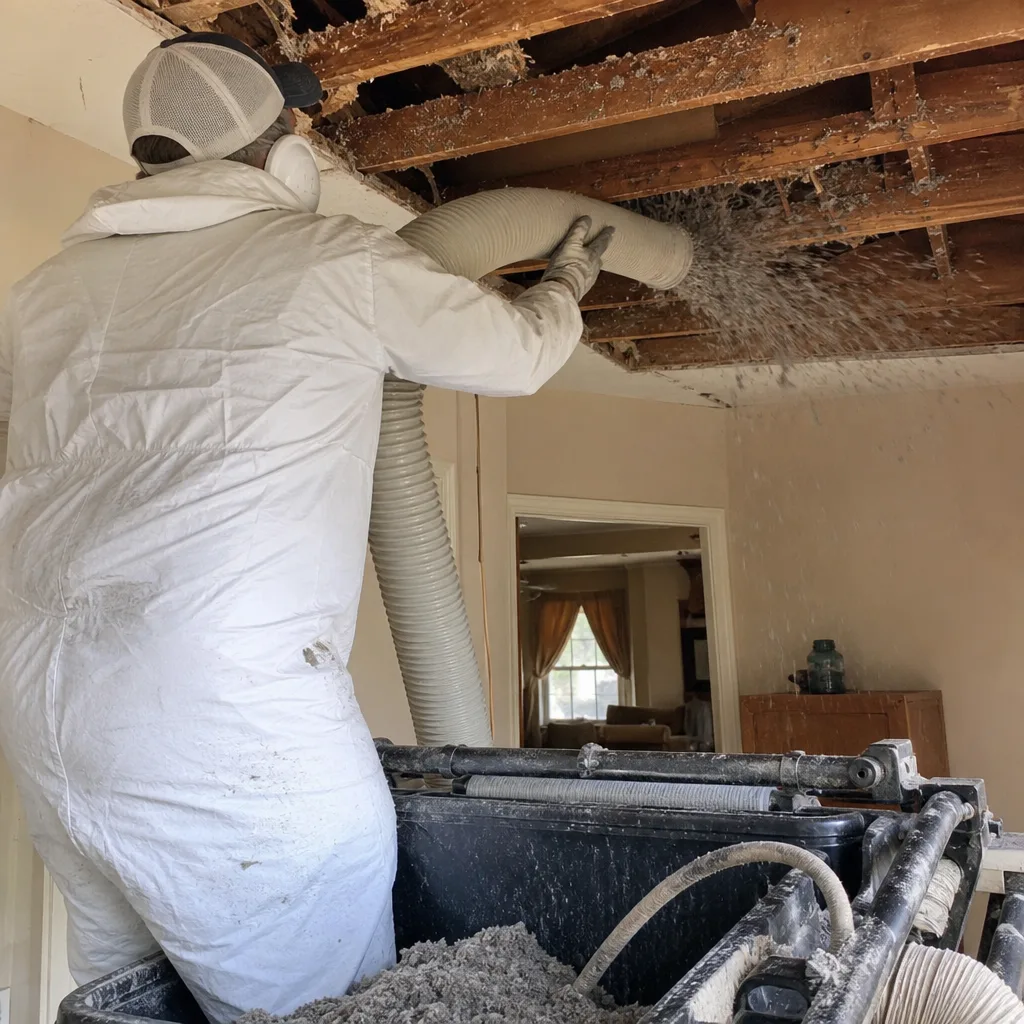
- Old Rockwool loose-fill from pre-1990 installations. Before batts became standard, Rockwool sold loose-fill mineral wool. In Woodland Hills homes built in the 1960s through the 1980s, we still find this material settled in attics at a fraction of its original depth. The R-value is shot. More importantly, the settling creates cold spots and warm spots across the ceiling. We remove loose-fill with a commercial vacuum system and replace it with a proper blown-in or batt product matched to the attic’s specific R-value target for our climate zone.
- DIY mistakes from Rockwool board installations. Rockwool’s rigid board products, like Comfortboard 80, show up in Woodland Hills remodel jobs where a previous contractor or homeowner used them to insulate knee walls or crawlspace ceilings. The problem we see: boards cut short or jammed in at the wrong angles, leaving gaps that let conditioned air escape. Gaps in a rigid board installation are worse than no insulation in some spots because they create convection loops. We remove the board, fix the framing or opening, and reinstall properly.
Our Rockwool Insulation Removal Process
Removing Rockwool is messy work, and doing it right matters more than doing it fast. Here’s how a typical Rockwool removal job goes with our crew, from first call to final walkthrough.
- 1
You call, we answer. A live person picks up at (559) 295-5362, 24/7. We ask about your attic size, when the house was built, whether you’ve seen rodents or leaks, and what’s already been done. You get a time window that’s live and trackable, not a four-hour shrug.
- 2
We inspect the attic and identify what’s actually in there. This matters more than you’d think, because Rockwool, fiberglass, and cellulose can look similar under dust and low light. We sample the material, identify the product type and condition, and check for moisture, rodent activity, and air sealing gaps.
- 3
We give you a written price. Before any work starts, you get a written price that covers the full removal, disposal, and any air sealing or replacement material we recommend. That price is the price; we don’t adjust it at the door.
- 4
We remove the Rockwool with proper equipment and containment. Depending on the situation, we use a commercial vacuum system for loose-fill or manual bagging for batts and board. We run poly containment to keep dust out of your living space, and our techs wear respirators and protective gear the entire time. We photograph the process so you see exactly what came out and how the space looked before and after.
- 5
We fix what caused the problem before we put anything back. Removal is half the job. If rodents were in the attic, we seal the entry points. If a roof leak caused water damage, we flag the area so you can get the roof fixed before new insulation goes in. We never install fresh material over a problem that’s still active.
- 6
We install the right replacement and document everything. Fresh batts, blown-in, or spray foam go in, matched to the R-value your Woodland Hills home needs for our climate. You get before-and-after photos, a written guarantee, and a digital invoice you can pay from a link. Every removal carries our 365-Day Done Right Promise: if it’s not right, we make it right, in writing, every time.
What Rockwool Insulation Removal Costs in Woodland Hills
Rockwool removal pricing in Woodland Hills depends on three things: the size of the attic, how difficult the access is, and what condition the material is in. Contaminated material, whether from rodents or water, takes longer to handle safely and costs more to dispose of properly. Here’s what we typically see:
- Attic under 1,000 sq ft, clean Rockwool batts: $1,200 – $1,800
- Attic 1,000 – 2,000 sq ft, mixed Rockwool and fiberglass: $1,800 – $2,800
- Attic 2,000+ sq ft or rodent-contaminated material: $2,800 – $3,800
- Loose-fill Rockwool removal with vacuum system: add $400 – $700 depending on depth and volume
- Replacement insulation after removal: quoted separately based on material and R-value; most Woodland Hills homes run $1,500 – $4,000 for a full attic re-insulation
Call (559) 295-5362 for an exact quote on your attic. Estimates are free, and the price we give you is the price you pay.
Why Woodland Hills Homeowners Call Laurel Attic Insulation Woodland Hills for Rockwool Work
Most insulation companies in the Valley will remove whatever’s in your attic and replace it with whatever’s on their truck. That’s not how we work. We carry professional-grade materials from eight manufacturers, so if Rockwool isn’t the right replacement for your situation, we’ll tell you what is; whether that’s Owens Corning for a standard batt job, CertainTeed for a specific R-value target, or Reflectix for a radiant barrier application. The brand matches the job, not our inventory sheet.
We’re an independent Rockwool service provider; we’re not affiliated with or authorized by Rockwool, and we’ll never pretend otherwise. What we offer is what Rockwool can’t from a spec sheet: live arrival tracking, before-and-after photo proof, a written price before work starts, and a 365-Day Done Right Promise that covers workmanship for a full year. Our techs know Rockwool products by name and by failure mode, because we’ve pulled enough of it out of Woodland Hills attics to know exactly what we’re dealing with.
Laurel stays green all year, and so should your home’s comfort. That’s the idea behind the name. We answer the phone 24/7, we show up when we say we will, and we put everything in writing before a single bag of insulation moves.
FAQs
In most cases, yes. A standard Rockwool removal in Woodland Hills takes one day for attics under 2,000 square feet. Larger attics, heavy rodent contamination, or multiple material types can push the job to a second day. Call (559) 295-5362 and we’ll give you a realistic timeline based on your attic’s specifics.
Adding insulation on top of damaged or contaminated Rockwool is cheaper short-term and a bad idea long-term. You’re sealing in rodent waste, moisture, and lost R-value, and you’ll pay to remove all of it later. The honest answer: if the Rockwool is dry, clean, and structurally intact, topping it off can work. If it’s not, removal is the right call. We’ll tell you which situation you have during the inspection, and we’ll show you the photos to prove it.
Rockwool doesn’t offer a warranty that covers removal or replacement labor in residential applications, so removing it doesn’t void anything meaningful. Our 365-Day Done Right Promise covers our workmanship regardless of material. If the removal or replacement isn’t right, we make it right at no charge, including a free second visit if the repair fails.
We schedule most Woodland Hills Rockwool inspections within 48 hours, and emergency removal for water-damaged insulation can happen sooner. We answer the phone live 24/7, so call (559) 295-5362 and we’ll get you on the calendar while you’re on the line.
Yes. We remove Reflectix radiant barrier, fiberglass, cellulose, spray foam, and mineral wool from any manufacturer. The process and equipment change depending on the material, but the pricing and guarantee structure are the same: written price before work starts, photo proof of every step, and the 365-Day Done Right Promise.
Written by Chase Whitaker, Owner, Laurel Attic Insulation Woodland Hills at Laurel Attic Insulation Woodland Hills, serving Woodland Hills and nearby areas.