
Owens Corning Radiant Barrier Installation: The Woodland Hills Owner’s Guide
Radiant barrier installation in Woodland Hills typically costs $750 to $1,900 installed, depending on attic square footage and access. We stock Owens Corning-compatible radiant barrier on our trucks, so most jobs in the 91364 and 91367 zip codes can be scheduled within 48 hours. The call we get most often starts the same way: a homeowner opens their electric bill after a July heatwave, notices their upstairs rooms won’t hold temperature, or peeks into the attic and finds the existing barrier has delaminated, torn, or pulled away from the rafters. That’s usually the moment they realize the barrier was stapled incorrectly years ago, or it’s simply hit the end of its life under a San Fernando Valley sun that bakes attic spaces to 140 degrees or hotter.
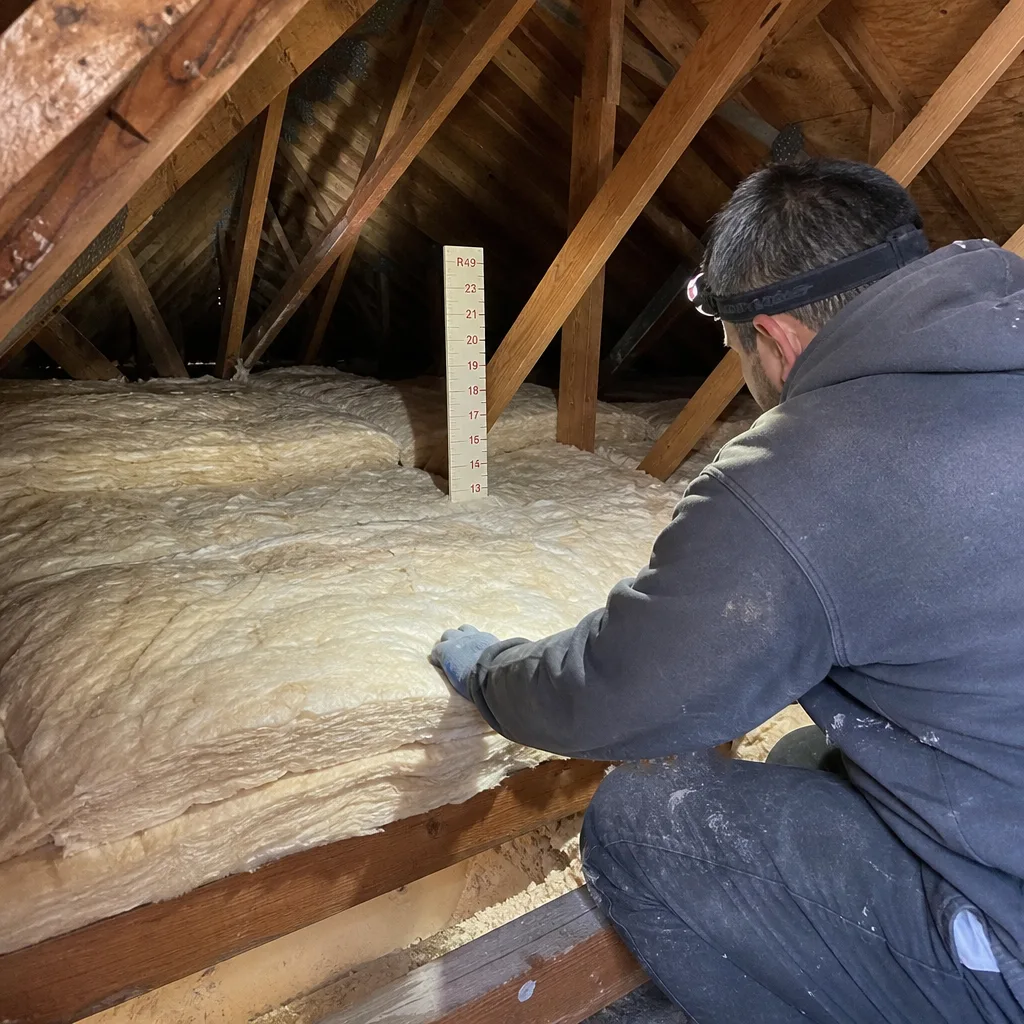
Here’s the thing most people don’t know: radiant barrier isn’t insulation. It’s a reflective surface, usually a foil-faced material, that bounces radiant heat away from your living space. In Woodland Hills, where summer attic temperatures regularly climb past 130 degrees, that reflection matters more than almost any other single attic upgrade. Owens Corning makes a specific perforated radiant barrier designed to breathe and avoid condensation trapping, and installing it correctly means the difference between a 20-degree attic temperature drop and a product that does basically nothing. We’ll get into what “correct” looks like below.
Key Takeaways:
- Installed radiant barrier in Woodland Hills runs $750 – $1,900 for most homes, with perforated Owens Corning-style barrier at the lower end and full attic encapsulation at the higher end.
- Same-week installation is standard for us; many Woodland Hills attics can be done in a single visit because we stock the material on the truck.
- Radiant barrier is a safety-neutral product to handle, but working in a 130-degree attic is not. We’ll be straight about what DIY looks like.
- Every job gets a written price before work starts, a written guarantee, and a free second visit if anything fails within 365 days.
Which Owens Corning Models This Applies To
Owens Corning sells radiant barrier in a few configurations, and the compatibility question usually comes down to perforation and facing. Their perforated radiant barrier, designed for open attic applications, allows moisture vapor to pass through so you don’t trap condensation against the roof deck. That’s the version most Woodland Hills homeowners need, because our winter rain season followed by dry summer heat creates exactly the moisture-cycling conditions that cause non-perforated barriers to hold water against wood. If you’re holding an Owens Corning radiant barrier product with small visible perforations across the foil face, that’s the open-attic version. If the foil is solid with no visible holes, it’s meant for walls or climate-controlled spaces, and installing it in an attic is a mistake we’ve corrected more than once.
The OEM-versus-aftermarket question for radiant barrier is different than for, say, a furnace board. Owens Corning’s radiant barrier is a commodity-style reflective product; the performance difference between their perforated foil and a quality equivalent like Reflectix (which we also carry) is real but small. What matters more is installation quality: the air gap, the staple pattern, and the coverage perimeter. We match the product to the attic, not the brand name to the box, but if you specifically want Owens Corning material on the job, we’ll install Owens Corning. We’re an independent installer, by the way, not affiliated with Owens Corning directly. We just happen to keep their product on the truck most weeks.
Signs Your Owens Corning Radiant Barrier Installation Is Failing
- Upstairs rooms run 5 – 8 degrees hotter than downstairs in summer. Radiant barrier reflects heat before it reaches your insulation. When it’s torn or sagging, that heat hits the insulation directly and the differential shows up in the rooms below the attic first.
- The foil has pulled away from the rafters and is hanging in sheets. Staples fail over time, especially in attics with high humidity swings. Once the barrier loses tension, the air gap collapses and it stops reflecting. This is the most common failure we see in Warner Center-area homes built in the 1980s and 90s.
- Dust coating on the foil face. A thick layer of dust kills reflectivity. Owens Corning barrier holds up well, but after 10 – 15 years in a dusty Woodland Hills attic, the shiny surface dulls and performance drops noticeably. If you can write your name in the dust on the foil, it’s compromised.
- Condensation staining on the underside of the roof deck. This usually means a solid, non-perforated barrier was installed in an open attic, trapping moisture against the wood. We’ve seen this cause actual rot in Woodland Hills homes near the hills where morning marine layer meets hot afternoons.
- Energy bills creeping up year over year with no obvious change in behavior. Radiant barrier failure is silent and gradual. If your AC bill is up 15 – 20% over three years and the unit checks out, the attic is where we look first.
Replacement Cost & What’s Included
For Woodland Hills homes, expect $750 to $1,900 installed for radiant barrier replacement, with the range driven mainly by attic square footage and access. A typical 1,200 – 1,600 square foot single-story home with standard truss spacing runs $900 to $1,300. Two-story homes with complex roof geometry, or attics with HVAC equipment and ductwork crowding the work area, push toward the higher end. The price is parts and labor together: material, removal of failed barrier where needed, re-stapling or full replacement, and cleanup. We don’t split out a separate “materials fee” after the fact.
The written quote you get before we start is what you pay. That’s not a line we use loosely. Every job includes the 365-Day Done Right Promise: if the installation isn’t right, we fix it, in writing, no charge. And if the job fails within that year, the second visit is free. No argument, no invoice, no phone tag. That guarantee applies to every radiant barrier job we do in Woodland Hills, same as every insulation removal or spray foam job.
DIY or Call Us?
Radiant barrier itself is not dangerous to handle. There’s no electricity, no high-tension components, no gas line anywhere near the job. The hazard in Woodland Hills is the attic itself. In July and August, an attic space can hit 140 degrees, and working in that heat is how people get heat exhaustion without realizing it until they’re already dizzy on a rafter. If you’re going to check your radiant barrier yourself, do it before 9 a.m., bring water, and don’t go up alone. Checking is fine. Replacing is where DIY goes sideways: you need a staple pattern that keeps tension without over-pulling, you need to maintain the air gap between the foil and the roof deck, and you need to avoid blocking soffit vents at the eaves. Get any of those wrong and you’ve spent a weekend installing a product that won’t work.
Our crews do this in a few hours with the right respirators, knee pads, and a plan for the heat. If you’ve looked at your attic and the barrier is sagging, torn, or coated in dust, call (559) 295-5362. We’ll come take a look, give you a straight answer, and put the price in writing before anything starts.
FAQs
Owens Corning radiant barrier typically lasts 10 to 20 years in Woodland Hills conditions, but dust accumulation and staple failure usually cut effective performance to the lower end of that range. The foil itself rarely degrades; it’s the installation points and surface reflectivity that fail first. If your barrier is 12 – 15 years old and you’re seeing uneven room temperatures, it’s worth an inspection. Call (559) 295-5362 and we’ll tell you what you’re actually working with.
Yes, in many cases a partial repair works fine: re-stapling loose sections and replacing torn panels covers probably 60% of what we see. If the barrier is heavily dust-coated or was installed without an air gap in the first place, replacement makes more sense than spot fixes. We’ll quote both options honestly and let you decide. Estimates are free.
Most Woodland Hills attics take 3 to 5 hours for an experienced crew, including removal of failed material and cleanup. Larger or more complex attics can run a full day. You’ll have a live arrival time, not a four-hour window, and we send before-and-after photos when the job is done.
We keep perforated Owens Corning radiant barrier on the truck, along with Reflectix as an equivalent option. If your attic requires a specific configuration we don’t have on hand, we can source it and schedule installation within a few days. Either way, you’ll know before we start what’s going in and what it costs.
Written by Chase Whitaker, Owner, Laurel Attic Insulation Woodland Hills at Laurel Attic Insulation Woodland Hills, serving Woodland Hills and nearby areas.