
GreenFiber Attic Insulation: The Woodland Hills Owner’s Guide
We stock and install GreenFiber attic insulation throughout Woodland Hills, with most jobs running $900 – $2,400 installed depending on square footage and the R-value your attic needs. If your GreenFiber insulation has settled, gotten wet from a roof leak, or been torn up by rodents, we can match it and get it replaced, often same-day. Most Woodland Hills homeowners discover the problem the hard way: an upstairs room that won’t hold temperature, a spike in the summer electric bill, or a cold spot directly under a section of ceiling that feels suspiciously thin.
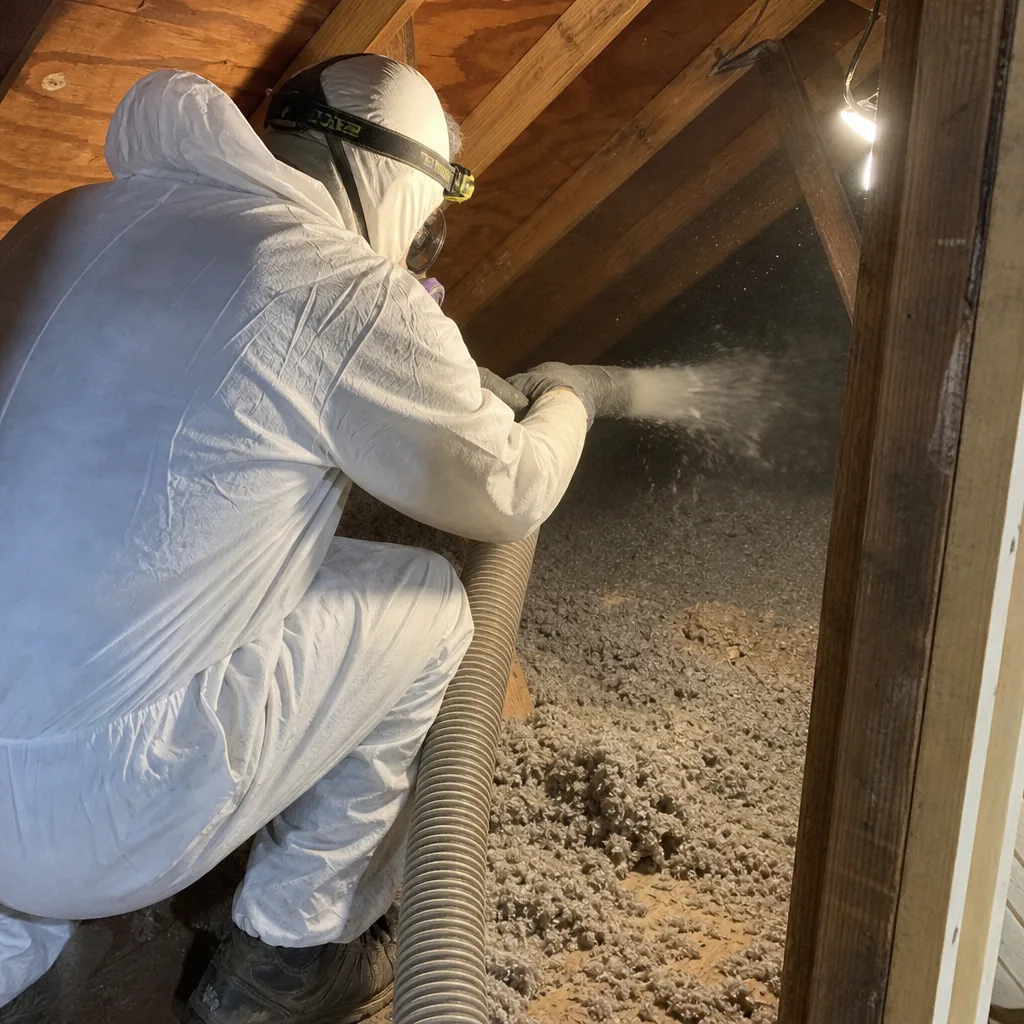
GreenFiber is a cellulose insulation made from recycled paper treated with borate for fire and pest resistance. It’s blown in, not rolled out. That’s the first thing to understand when something goes wrong: you’re not replacing a bat that comes out in one piece. You’re dealing with loose-fill material that compacts over time and loses R-value, or that holds moisture after a leak and turns into a matted mess that insulates about as well as wet newspaper. Chase Whitaker has pulled out plenty of GreenFiber that was more dust than insulation after years of compression in Woodland Hills attics where summer heat bakes the underside of the roof to 140-plus degrees.
Key takeaways:
- GreenFiber installed in Woodland Hills attics typically costs $900 – $2,400, depending on square footage and target R-value.
- Settling of 20 – 30% is normal for loose-fill cellulose; if you started at R-38 and now measure R-25, that’s not a product defect – it’s physics, and it’s fixable.
- Water-damaged GreenFiber cannot be dried and re-blown. It has to come out.
- We’re an independent insulation contractor, not affiliated with GreenFiber. That means we stock what actually works on the truck, not what a single brand pushes.
Which GreenFiber Models This Applies To
GreenFiber sells its cellulose insulation under a few product names that all behave the same way in an attic: SANCTUARY, InsulFill, and the standard GreenFiber Cellulose Blow-In Insulation. The differences are mostly in marketing and bag size, not in how the material performs once it’s in your attic. What matters more is the R-value you originally paid for, and what’s actually left up there now.
Here’s the compatibility gotcha most Woodland Hills owners run into: loose-fill cellulose like GreenFiber is not a “part” you match by model number. It’s a material you match by installed R-value. Bag coverage charts assume ideal conditions at installation: fluffed to spec, no settling, no moisture. Reality in a San Fernando Valley attic is different. Dry heat accelerates settling, and the first few inches compact fast. If you’re adding new GreenFiber on top of old GreenFiber, you don’t need to match bag lots or batches – cellulose is cellulose. You need to match density and understand how much the existing layer has settled before you calculate how many new bags to blow.
We also stock material from seven other manufacturers, Owens Corning, Johns Manville, Knauf, Rockwool, CertainTeed, Icynene, and Demilec, plus reflective products from Reflectix. Chase Whitaker will tell you straight: if your attic is better served by a fiberglass topper or a spray foam air seal with GreenFiber on top, that’s what we’ll recommend. The material gets matched to the job, not to whatever is already loaded on the truck.
Signs Your GreenFiber Attic Insulation Is Failing
- Upstairs rooms run 5 – 8 degrees warmer than the rest of the house in summer. This is the classic settling signal. Cellulose compacts under its own weight, and once you’ve lost 30% of your depth, you’ve lost a proportional chunk of your R-value. A Woodland Hills attic that started at R-38 can easily be performing at R-26 within a decade.
- Your July or August electric bill jumped without a rate change or a new appliance. Air conditioning works harder when attic insulation underperforms. The heat load through the ceiling is constant. More heat getting in means longer compressor run times. You’ll see it on the bill before you feel it in the room.
- You can see dark streaks or staining on the insulation near recessed lights or bathroom fans. That’s air movement, not insulation failure. Warm, moist air is being pulled through gaps around ceiling penetrations and filtering through the cellulose. The GreenFiber catches the dust and dirt. It’s an air-sealing problem wearing an insulation costume.
- The insulation feels damp, matted, or smells musty when you poke your head up there. Cellulose and moisture are a bad combination. A roof leak, a disconnected bathroom vent, or condensing ductwork all saturate GreenFiber and it never dries out properly in a closed attic. Wet cellulose loses almost all insulating value and can hold moisture against framing.
- Rodent droppings or nesting tunnels through the insulation. Cellulose treated with borate resists pests better than untreated fiberglass, but determined rats and mice will tunnel through anything. Once they’ve burrowed paths, you lose thermal continuity and gain a sanitation issue. The material needs removal, not a topper.
Replacement Cost & What’s Included
Installed GreenFiber attic insulation in Woodland Hills typically lands between $900 and $2,400. The range is driven by square footage, current R-value, target R-value, and how much prep work the attic needs before new material goes in. Smaller attics under 1,000 square feet with an easy hatch and no air-sealing work run toward the low end. Larger attics, deeper target R-values, removal of wet or pest-damaged material, can drop ceilings, difficult access, and air-sealing around penetrations push toward the top.
| Scope | Typical Woodland Hills Price |
|---|---|
| Top-off existing attic, 800 – 1,200 sq ft, add R-19 over settled GreenFiber | $900 – $1,400 |
| Full removal of failed GreenFiber + new R-38 blown install, 1,200 – 1,600 sq ft | $1,600 – $2,400 |
| Air-sealing package (recessed lights, top plates, plumbing chases) added to insulation work | $300 – $600 |
Every quote is a written price before any work starts. No door-step adjustments, no “we found something once we got up there” surprises that weren’t documented first. The workmanship is covered by our 365-Day Done Right Promise in writing, and if something fails within that year, the second visit is free. Materials from GreenFiber and seven other manufacturers mean we’re not married to one product when another would do the job better.
DIY or Call Us?
You can safely check your own attic for the obvious signs: measure the insulation depth with a tape measure, look for damp spots, check for rodent sign. That’s useful information and it’ll make your phone call shorter. What you shouldn’t do is try to blow GreenFiber yourself with a rental machine from a big-box store. The safety issues are real: attics in Woodland Hills hit 140 degrees in summer, you’re walking on ceiling joists in a space built for storage not walking, and loose-fill cellulose creates dust that demands a proper respirator, not a paper mask. Electrical wiring, recessed light housings, and the fall risk through the ceiling drywall make this a job for people who do it every day.
And there’s the practical side. A rental blower and a pile of bags from the home center will save you maybe $400 on the low end. That’s real money. But you’ll also get inconsistent density, no air-sealing, and no guarantee on the work. If the insulation settles in six months, you get to do it again. Our crews work in this every day. We know which corners of a Warner Center-era attic hide surprises. Call (559) 295-5362 and we’ll tell you over the phone whether this job is worth paying us to do, or whether you’re fine for another year.
FAQs
GreenFiber cellulose lasts 20 – 30 years in a dry, undisturbed Woodland Hills attic, but it loses R-value as it settles, with most of the settling happening in the first two years. The material doesn’t rot or degrade on its own; the California reality is that heat accelerates settling and any moisture event shortens its useful life fast. If your attic is dry and deep, age isn’t the enemy. Settling and leaks are.
Settled GreenFiber doesn’t need removal, it needs a top-off, and that’s the cheapest fix: fluff the existing layer, air-seal the gaps, and blow new material on top to restore the target R-value. Water-damaged or pest-infested GreenFiber is a different story, and that’s a removal-and-replace job, not a repair. If you’re not sure which one you have, call (559) 295-5362 and describe what you’re seeing. We’ll tell you straight.
A standard top-off on a 1,200-square-foot Woodland Hills attic takes one day, usually four to six hours including setup and cleanup; full removal of failed material and a new install takes a second day. Air-sealing work adds a few hours. You’ll get a written time estimate with your quote, and you’ll see our technician arrive at a live, trackable time, not a four-hour window.
We keep GreenFiber and matching products from seven other manufacturers available for same-week scheduling, and our trucks carry the most common R-value top-off material for same-day jobs in Woodland Hills. We’ll confirm material availability when you book. You’re not waiting on a special order unless the job calls for something unusual.
Call Laurel Attic Insulation Woodland Hills Today
If your GreenFiber attic insulation is underperforming, settling, or holding moisture, the fix is straightforward and we’ll price it in writing before anyone climbs a ladder. Calls are answered by a live person 24/7. No voicemail, no callback queue. Call (559) 295-5362 for a free estimate, and we’ll give you the real numbers for your Woodland Hills attic, not a scripted range.
Written by Chase Whitaker, Owner, Laurel Attic Insulation Woodland Hills at Laurel Attic Insulation Woodland Hills, serving Woodland Hills and nearby areas.