
Demilec Radiant Barrier Installation: The Woodland Hills Owner’s Guide
We install Demilec radiant barrier systems throughout Woodland Hills, and a typical radiant barrier installation runs $1,100 – $2,800 depending on attic square footage, roof pitch, and whether we’re pairing it with new insulation. Most jobs are completed same day, and we stock the materials on our trucks. The usual call we get starts the same way: a homeowner notices the upstairs bedrooms won’t hold temperature in August, walks up into the attic, and finds the foil facing is torn, sagging, or pulling away from the rafters.
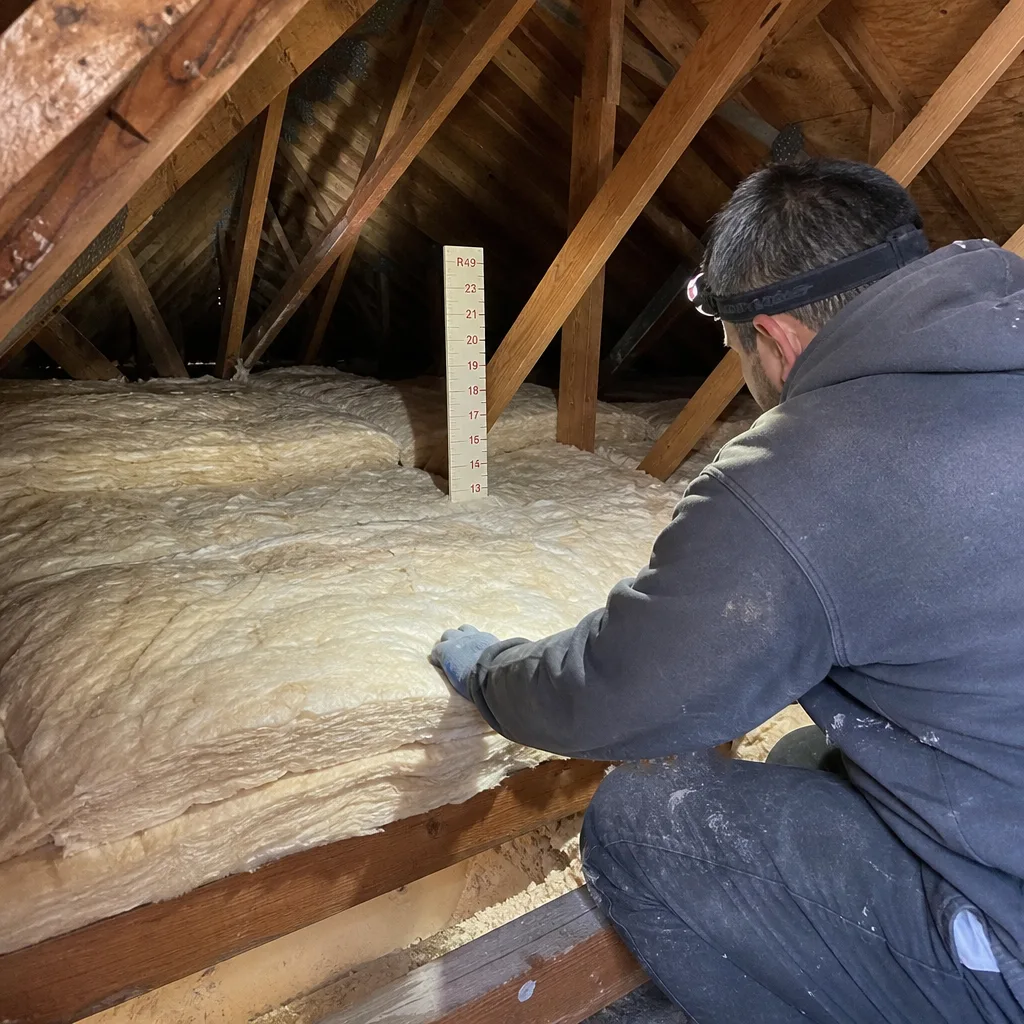
Radiant barrier is a foil-faced material that reflects heat away from your living space before it ever reaches your insulation. In Woodland Hills, where summer attic temperatures routinely hit 140°F or more, that reflection is doing real work. When the barrier fails, your insulation absorbs more heat, your AC runs longer, and your upstairs rooms never quite cool down. The fix is straightforward: remove the degraded sections, prep the rafter bays, and install new Demilec-compatible radiant barrier with proper air gaps. Chase Whitaker has diagnosed hundreds of these failures across the San Fernando Valley, and the pattern is usually the same: heat cycling plus poor initial stapling.
Here’s what every Woodland Hills homeowner should know before calling anyone:
- Demilec radiant barrier works by emissivity, not thickness. A low-e (emissivity) rating of 0.05 or lower is what you want. Higher numbers mean less reflection.
- Installed radiant barrier typically pays for itself in 3 – 5 years in Woodland Hills AC loads, sooner if your attic is large and your ductwork runs through it.
- We’re an independent installer. We’re not affiliated with Demilec, but we stock Demilec-compatible barrier and install it to manufacturer spec.
- Every job includes a written price before work starts and the Relay Visibility Guarantee: live arrival tracking and photo proof when we’re done.
Which Demilec Models This Applies To
Demilec’s radiant barrier lineup has shifted over the years, and the naming conventions aren’t always obvious. The barrier products we install and service in Woodland Hills fall into two broad groups: perforated foil radiant barrier (often branded under the HeatBloc or reflective insulation line) and solid foil radiant barrier used in hotter, drier attic spaces. The perforated version matters here: it allows moisture vapor to pass through, which prevents condensation against the roof deck during Woodland Hills’ cooler, damp winter mornings.
Here’s the compatibility gotcha most homeowners miss: radiant barrier only performs when there’s an air space of at least 3/4 inch on one side. Foil pressed flat against the roof deck or buried under insulation is doing close to nothing. When Demilec barrier is stapled incorrectly, usually to the face of the rafter instead of creating a continuous reflective plane across the rafter bay, it still looks right from the attic floor, but the emissivity advantage disappears. We’ve corrected plenty of installations in Warner Center homes where the previous contractor skipped the air gap entirely.
For older Demilec installations from the mid-2000s, the foil facing tends to delaminate from its backing after 10 – 15 years of San Fernando Valley heat cycling. Newer Demilec products hold up better, but any radiant barrier in this climate will eventually need sectional replacement. When we assess a job, we look for the Demilec product label on the attic floor or gable end; if the label is gone, we measure foil thickness and perforation pattern to determine whether we’re matching like-for-like or recommending an upgrade.
We also stock Reflectix radiant barrier products for replacement work where the original install used that brand, and we’re happy to match either. The performance difference between quality radiant barrier products is smaller than most people think: what matters is the installation, the air gap, and how well the seams are sealed.
Signs Your Demilec Radiant Barrier Installation Is Failing
- Upstairs rooms run 5 – 8°F warmer than downstairs during summer afternoons. Radiant barrier failure means your insulation is absorbing direct radiant heat instead of reflecting it. The symptom shows up first in bedrooms sitting directly under the roof deck.
- Foil facing is sagging, torn, or hanging from the rafters. Heat and humidity cycles break down the mechanical bond between the foil and its substrate. Once the barrier loses tension, it stops reflecting and starts trapping.
- Your AC runs noticeably longer on hot days, even when the thermostat setting hasn’t changed. This one’s subtle. Track your daily kWh or runtime hours. A failed radiant barrier adds real thermal load to your cooling system.
- Dust has accumulated on the foil’s reflective surface. It seems like a small thing, but a layer of attic dust dramatically reduces emissivity. In Woodland Hills, where the hills trap dust and the Santa Anas carry more of it, this is a common issue after a few years.
- You can see light or air gaps around recessed lights and other ceiling penetrations from inside the attic. We often find radiant barrier failures paired with air-sealing problems. The heat and conditioned air are both escaping through the same weaknesses. If your attic is under-insulated, your AC is just paying rent to the outside air.
Replacement Cost & What’s Included
For a typical Woodland Hills single-family home, Demilec radiant barrier installation runs $1,100 – $2,800 installed. The spread is driven by attic size, roof complexity, accessibility, and whether we’re doing sectional replacement or a full attic. Smaller ranches in the 1,200 – 1,500 sq ft range usually land toward the bottom. Larger two-story homes with steep or complex roof lines land higher.
Here’s the line-item breakdown for a typical 1,800 sq ft Woodland Hills attic:
- Radiant barrier material (Demilec-compatible, perforated): $400 – $900 depending on square footage and foil type.
- Labor for installation with proper air gap and seam sealing: $500 – $1,400 depending on roof pitch and rafter accessibility.
- Air sealing at penetrations (optional but recommended): $150 – $400 for recessed lights, plumbing chases, and top plates.
- Removal and disposal of failed barrier sections: $100 – $250 when applicable.
Every quote we give in Woodland Hills is written and delivered before any work starts. The price we hand you is the price you pay. Our 365-Day Done Right Promise covers workmanship for a full year, and if the repair fails during that time, you get a free second visit, no charge, no argument. The guarantee is delivered with your digital invoice, and you can pay from the link.
DIY or Call Us?
Radiant barrier installation isn’t a high-tension spring or an electrical panel, so the physical danger is lower than a lot of attic work. The risks here are heat stress, falls through ceiling joists, and doing all that work for a result that doesn’t perform. An attic in Woodland Hills during the daytime can hit 140°F. You need to work early morning, hydrate more than you think, and move carefully on joists you can actually see. People fall through ceilings every year because they stepped on drywall instead of a joist.
What you can safely check yourself: head up with a flashlight, note whether the foil is sagging or torn, and check whether there’s a visible air gap between the barrier and the roof deck. That’s useful information to have before you call. What usually goes wrong with DIY: the air gap gets skipped, seams aren’t sealed, and the barrier ends up pressed flat against the deck where it does nothing. At that point you’ve spent a weekend and a few hundred dollars to make your attic look reflective while your AC keeps working just as hard.
If you’d rather have it measured, priced, and installed by someone who does this every week, call us at (559) 295-5362. We’ll come out, take real measurements, and give you a written price before anything starts.
FAQs
Demilec radiant barrier typically lasts 10 – 15 years in the San Fernando Valley climate before the foil begins to delaminate or lose meaningful reflectivity. Heat cycling is the main culprit; Woodland Hills attics see extreme temperature swings between summer days and winter nights, and that thermal expansion and contraction gradually breaks down the bond between foil and substrate. If your barrier is older than 10 years and your upstairs rooms are struggling, it’s worth an inspection. Call (559) 295-5362 for a free estimate, and we’ll tell you honestly whether you need replacement or if your current barrier still has life in it.
Yes, small tears and detached sections can often be repair-stapled and seam-sealed, especially if the surrounding material is still in good shape. The repair makes sense when the damage is localized, usually under 20% of the total attic square footage. Larger failures, or barrier that’s delaminated across multiple rafter bays, generally warrant sectional or full replacement, because patching degraded foil is like putting a fresh coat of paint on a rusted panel. Tell us what you’re seeing during a call, and we can usually give you a sense of repair vs. replacement before we even come out.
A typical Woodland Hills attic radiant barrier installation is completed in a single day, usually 4 – 7 hours depending on attic size and roof complexity. We arrive at a live, trackable time, not a vague window, and when the job is done you get before-and-after photos showing exactly what was installed. Sectional repairs can often be done in under 3 hours. Want the exact timeline for your attic? Call (559) 295-5362, and we’ll schedule a measurement visit.
Yes, our trucks carry Demilec-compatible perforated and solid foil radiant barrier, plus Reflectix products for brand-matching on older installations. We keep enough material for most single-day jobs on hand, which means no waiting for a supplier delivery. If your job requires a specialty product or an unusual attic configuration, we’ll tell you that upfront and schedule accordingly. Free estimates by phone or in person: call (559) 295-5362.
Written by Chase Whitaker, Owner, Laurel Attic Insulation Woodland Hills at Laurel Attic Insulation Woodland Hills, serving Woodland Hills and nearby areas.