
Icynene Vapor Barrier Installation: The Woodland Hills Owner’s Guide
Icynene vapor barrier installation in Woodland Hills typically runs $850 – $1,900 installed, depending on square footage and whether we’re reinstalling barrier over existing spray foam or starting fresh. We keep Icynene-compatible vapor barrier materials on our trucks, so most jobs in Woodland Hills are done same-day or next-day. The usual story we hear: a homeowner notices condensation on ceiling drywall, a musty smell in the upstairs hallway, or peeling paint near attic access points – and the culprit is a vapor barrier that’s torn, improperly lapped, or missing entirely around an Icynene spray foam application.
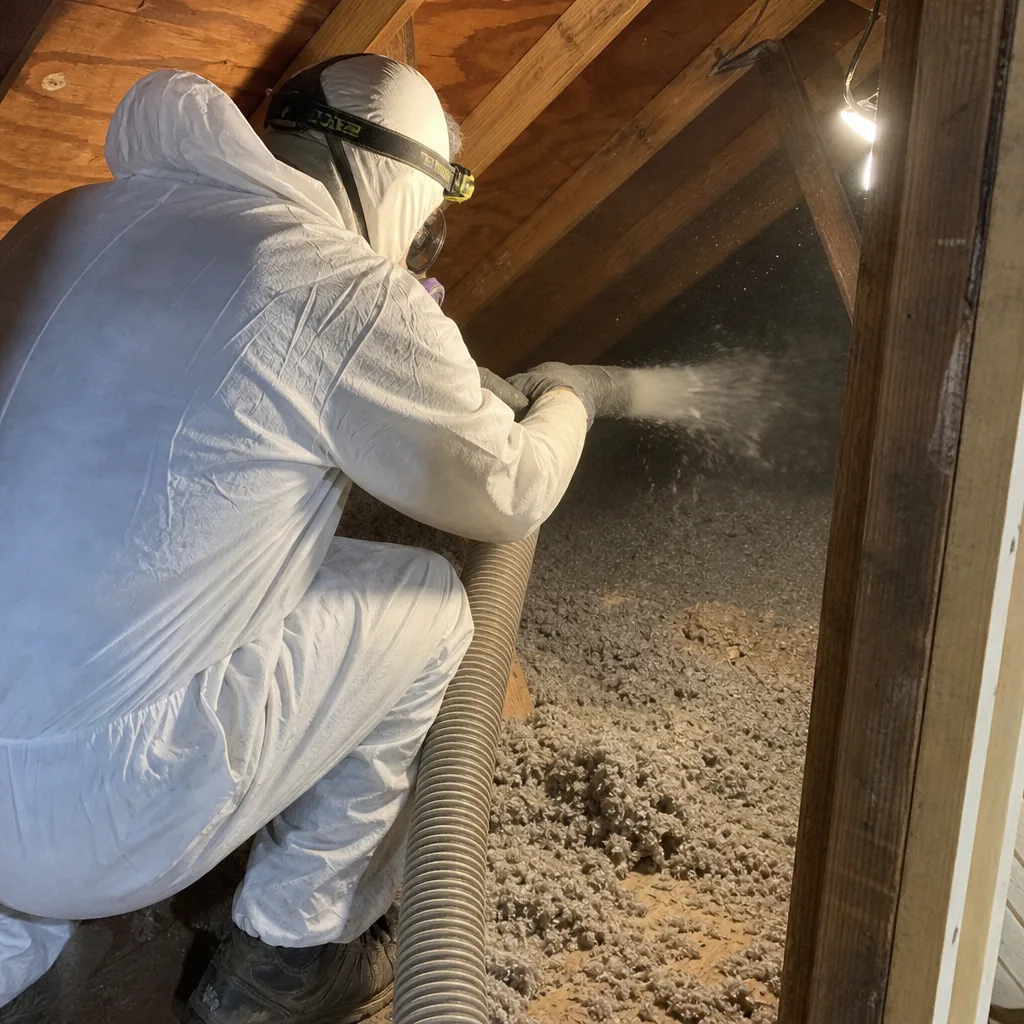
Here’s the thing about Icynene foam: it’s open-cell, which means it breathes. That’s great for flexibility and sound dampening, but it also means the vapor barrier does more work than most people realize. In Woodland Hills, where summer humidity creeps into attics and winter rains saturate the air, a compromised barrier lets moisture migrate into places it shouldn’t. Chase Whitaker has pulled back enough failed barriers in Warner Center-area homes to tell you exactly where they fail first: the seams.
Which Icynene Models This Applies To
Vapor barrier installation pairs with Icynene’s open-cell spray foam lines – primarily Classic, Classic Max, and ProSeal. Open-cell foam has an R-value around R-3.6 to R-3.8 per inch, and because it’s vapor-permeable, the barrier isn’t optional. It’s the layer that keeps moisture from passing through the foam and condensing on your ceiling assembly. If you’ve got Icynene’s closed-cell products (like MD-C-200), the vapor barrier conversation is different – closed-cell acts as its own vapor retarder at certain thicknesses, and adding an additional barrier can actually trap moisture between layers. That’s a compatibility gotcha most contractors in Woodland Hills never mention.
How to identify what you need: check the foam itself. Open-cell Icynene is soft and spongy, almost like a foam mattress – you can press a finger into it. Closed-cell is rigid. If you’re seeing condensation or damp drywall with soft, spongy foam above it, you need a vapor barrier installed. We recommend a 6-mil poly barrier rated for continuous contact with spray foam, which costs a bit more than the 4-mil stuff you’ll find at big-box stores, but it resists tearing during installation and holds up far better in Woodland Hills attics that regularly hit 130°F in August.
Quick note on brand: Laurel Attic Insulation Woodland Hills is an independent service provider. We install Icynene products and Icynene-compatible components, but we’re not affiliated with or endorsed by Icynene. We also carry Reflectix radiant barrier for jobs where heat reflection matters more than vapor control.
Signs Your Icynene Vapor Barrier Installation Is Failing
- Condensation on ceiling drywall or around light fixtures. This is the classic sign. Warm, moist indoor air is hitting a cold surface because the barrier above it has a gap. We see this most often around recessed lights in Woodland Hills homes, where barrier installation around penetrations gets sloppy.
- Musty or earthy smell in upstairs rooms or hallways. Moisture trapped between the barrier and drywall breeds mildew. By the time you smell it, the barrier has been compromised for a while, and you may have secondary damage to assess.
- Peeling paint or bubbling texture on ceilings. Moisture wicking through drywall breaks the paint bond. This is especially common in Woodland Hills homes built in the ’70s and ’80s, where original vapor barriers were stapled, not sealed, and have long since failed.
- Sagging or drooping barrier visible in the attic. If you can see the barrier pulling away from rafters or pooling with condensation, it wasn’t installed with enough mechanical fastening, or the seams weren’t lapped and sealed correctly. Improper lapping is the single most common install mistake we correct.
- Unexplained spike in cooling costs during humid months. When moist air saturates open-cell foam, its R-value drops. Your AC works harder to maintain the same temperature in Woodland Hills summers. If your energy bill jumped and you can’t explain it, the vapor barrier is worth a look.
Replacement Cost & What’s Included
In Woodland Hills, expect to pay $850 – $1,900 for Icynene vapor barrier installation, with most single-story homes landing around $1,100 – $1,400. Two-story homes with complex attic geometry run higher because there’s more cutting, fitting, and sealing around trusses, ducts, and penetrations. Here’s the line-item breakdown:
- 6-mil vapor barrier material: $0.15 – $0.25 per square foot, depending on attic layout
- Labor (removal of failed barrier + installation): $500 – $1,100 for typical Woodland Hills attics
- Seam sealing, tape, and mechanical fasteners: $75 – $200
- Disposal of old, torn barrier material: $50 – $100
Every job we do in Woodland Hills includes a written price before work starts. No “we’ll see once we’re in there” adjustments. We deliver that price digitally, along with the Relay Visibility Guarantee: live technician tracking, before-and-after photos, and a written guarantee on the installation. Our workmanship is covered by the 365-Day Done Right Promise – if the barrier fails within a year, we come back and make it right. If it fails after that, our free second visit for repair still applies. No charge, no argument.
DIY or Call Us?
You can absolutely inspect your own vapor barrier. Go into the attic, look for sagging, tears, or gaps at seams and around penetrations. That’s safe, and it tells you whether you have a problem. What gets people in trouble is the install itself. Attic work in Woodland Hills summers is dangerous – 130°F-plus heat, blown-in insulation hiding joists, and tight spaces where one wrong step puts your foot through the ceiling. Vapor barrier installation also fails silently if done wrong. A seam that’s overlapped 2 inches instead of 6, or a staple pattern that’s too sparse, won’t show itself for months until you’re repainting a water-stained ceiling.
Honestly? If your Icynene foam is open-cell and your barrier is compromised, you’ve already got moisture where it doesn’t belong. Call (559) 295-5362 and we’ll get a technician to your Woodland Hills home with the right materials, a live arrival time, and a written quote before we touch anything.
FAQs
A properly installed 6-mil vapor barrier over Icynene open-cell foam lasts 15 – 20 years in Woodland Hills’ climate, though attic heat cycles will eventually degrade the material and you’ll see brittleness at the seams first. Call (559) 295-5362 if your barrier is over 10 years old and you’re noticing condensation – the inspection is worth your time.
Small tears under 6 inches can often be patched with vapor-rated tape, but if the failure is at multiple seams or the barrier is pulling away from rafters, replacement is the honest fix. We’ll tell you which route makes sense after we see it – and the quote is free.
Most Woodland Hills attics take 4 – 8 hours from setup to cleanup, so same-day installation is common. Larger two-story homes can run into a second day. We’ll give you a time window before we start, not after we show up.
Yes. Our technicians carry 6-mil poly vapor barrier, vapor-rated seam tape, and mechanical fasteners on every truck so we can handle most Woodland Hills jobs in one visit. No “we’ll order it and come back next week.”
If your Icynene vapor barrier has failed, call (559) 295-5362 for a free estimate. We’ll give you a written price, a live arrival time, and photo proof of the work when it’s done. That’s how we do every job in Woodland Hills.
Written by Chase Whitaker, Owner, Laurel Attic Insulation Woodland Hills at Laurel Attic Insulation Woodland Hills, serving Woodland Hills and nearby areas.