
Icynene Attic Insulation: The Woodland Hills Owner’s Guide
If your Icynene attic insulation is failing, we stock Icynene-compatible open-cell and closed-cell spray foam in Woodland Hills, and most retrofit jobs run $1,200 – $3,800 installed depending on square footage and foam type. We can usually be in your attic within 48 hours, often same-day if the crew schedule lines up. Most Woodland Hills homeowners discover a problem one of two ways: they spot a dead spot in the foam where it separated from the roof deck, or they notice their upstairs bedroom is suddenly cooking in August while the AC runs nonstop. Sometimes it’s both. Either way, the fix is rarely a full re-spray, it’s a targeted removal of the failed section and a compatible re-application.
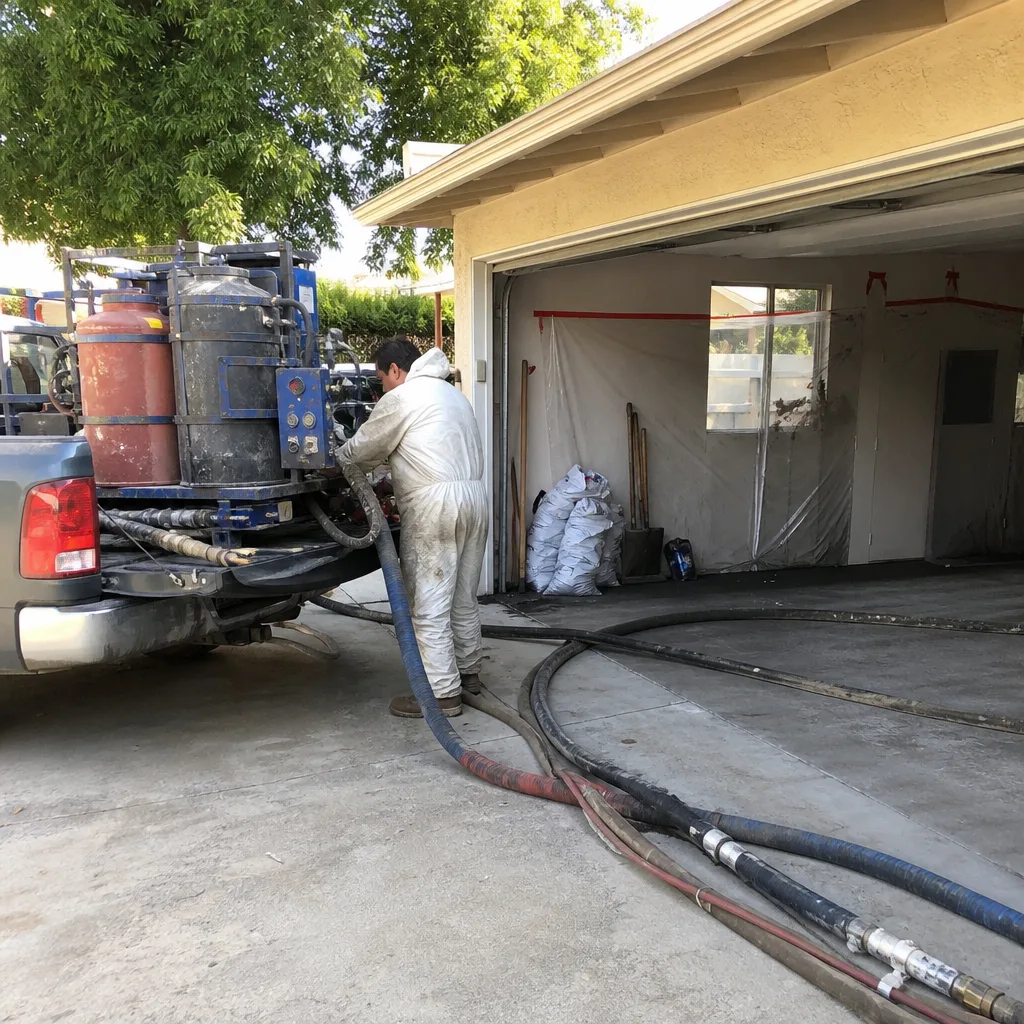
Here’s what you actually need to know about Icynene foam in this climate: Woodland Hills hits 100°F regularly in summer, and that heat-cycling is harder on spray foam than most people realize. Foam that looked perfect ten years ago can pull away from rafters after thousands of expansion-and-contraction cycles. That’s a checkable reality we see in attics along Ventura Boulevard and up through the hillside neighborhoods south of the 101.
Which Icynene Models This Applies To
Icynene has produced several foam lines over the years, and compatibility matters more than most homeowners think. The big ones we work with in Woodland Hills attics are Icynene Classic (open-cell, ~0.5 lb density), Icynene ProSeal (closed-cell, ~2 lb density), and the newer Icynene ProSeal LE (low-VOC closed-cell). If your home was built or retrofitted between 2005 and 2018 in this area, it’s almost certainly Classic or ProSeal original formula. You can’t always tell by looking, but the foam’s texture and density give it away fast: Classic feels spongy and you can dent it with a thumb, ProSeal feels rigid and sounds almost hollow when you tap it.
Here’s the gotcha most people don’t know: you shouldn’t spray a different brand’s foam directly against failed Icynene and call it done. Open-cell and closed-cell have different expansion and moisture-vapor characteristics, and layering incompatible chemistries can create a vapor trap. We cut out the failed section clean to the rafters or deck, then re-apply an Icynene-compatible product that matches the original density. For aftermarket equivalents, we lean on Demilec and CertainTeed open-cell foams when a full replacement makes more sense for the budget, and we’ll tell you that plainly before we quote anything.
Signs Your Icynene Attic Insulation Is Failing
- Upstairs rooms are 8 – 12°F warmer than downstairs in summer. Failed open-cell foam loses its air-seal first, which means hot attic air finds its way into the conditioned envelope. The temperature split between floors is usually the first thing people notice in Woodland Hills, because our summer heat makes the contrast dramatic.
- You can see gaps between the foam and the rafters or roof deck. This is the classic Icynene failure mode: the foam shrinks or pulls away, leaving a visible dark crack along the roofline. If you can slide a paint stir stick into the gap, air is moving through it.
- Your energy bill climbs in July and August without any change in usage. A 15 – 20% jump in cooling cost from one summer to the next, with the same thermostat settings, often traces back to lost attic air-sealing. The foam isn’t doing its job anymore, and your AC is working overtime to compensate.
- The foam feels brittle, discolored, or crumbly in spots. Closed-cell foam that’s been overheated or exposed to a roof leak for years can degrade. Discoloration from rusting nails or a slow leak stains the foam, and the chemistry breaks down where moisture sat.
- You smell a musty or “attic” odor in upstairs bedrooms. Open-cell foam that stays damp can hold moisture against the roof deck. In Woodland Hills, this usually means a roof leak or a bathroom vent that’s dumping moist air directly into the foam instead of through a proper duct to the exterior.
Replacement Cost & What’s Included
In Woodland Hills, expect $1,200 – $3,800 for a typical Icynene attic repair or replacement, with most jobs landing around $2,200 – $2,800. What drives the range: the square footage of failed foam, whether it’s open-cell or closed-cell (closed-cell costs more per board foot), access difficulty in your attic, and how much prep work the old foam requires. We price by the board foot after measuring, and we give you a written price before anything gets sprayed. That price includes removal of the failed section, substrate prep, the new foam itself, and cleanup. Every job carries our 365-Day Done Right Promise in writing, and if something fails within that year, we come back and make it right at no charge. If the repair fails a second time, you get a free second visit, no argument.
Chase Whitaker has torn out enough failed foam in Warner Center-area buildings to tell you this: the cheapest quote is rarely the cheapest when you’re fixing someone else’s rushed removal job. We cut the failed section out clean, check the air-sealing around every penetration while we’re up there, and re-apply at the correct thickness for your roof assembly. R-value means nothing if the foam isn’t bonded to the deck.
DIY or Call Us?
Spray foam is not a DIY material. The chemicals are toxic during application, the equipment runs at high pressure and high temperature, and a bad application creates a worse problem than the one you started with, especially in a confined attic. What you can safely do is inspect: look for visible gaps along the rafters, check for foam that’s pulling away or crumbling, and take photos so you can describe what you see when you call. Don’t cut into the foam, don’t try to patch it with canned foam from the hardware store (that’s a different chemistry that won’t bond properly to Icynene), and don’t climb around on joists if you’re not sure what’s structural.
If you’re not certain what you’re looking at, call us at (559) 295-5362. We’ll walk through what you’re seeing, and if we need to come out, you get a written quote before any work starts. That’s the same promise on a $1,200 patch job as it is on a $3,800 full re-spray.
FAQs
Icynene foam typically lasts 20 – 30 years when installed correctly, but Woodland Hills heat-cycling shortens the effective life of the air-seal, especially on south-facing roof slopes that bake all summer. We see original-Icynene homes from the mid-2000s in this area starting to show failure now. Call (559) 295-5362 if your attic foam is over 15 years old and you’re noticing temperature swings.
Yes, in most cases a failed section can be cut out and re-sprayed without touching the rest of the attic. Full replacement only makes sense when more than about 40% of the foam has failed or the existing foam was installed too thin to begin with. We’ll tell you which path makes sense for your specific attic, and the written quote reflects exactly what you need, not what’s easiest for us.
A typical sectional repair takes 4 – 6 hours from start to finish, including removal, prep, spray, and cleanup. Full attic replacements run one to two days depending on size. You’ll get a live arrival time before we show up, and before-and-after photos of the work so you can see exactly what was done.
We stock open-cell and closed-cell Icynene-compatible foam plus quality aftermarket options from Demilec and CertainTeed, along with Reflectix for radiant barrier applications where that’s the right call. The material gets matched to your existing foam type after we inspect it, not to whatever happens to be on the truck. Call (559) 295-5362 and we’ll confirm what your attic needs.
If your attic is under-insulated, your AC is just paying rent to the outside air. We’d rather put that money back in your pocket. Call (559) 295-5362 for a free estimate, a straight answer, and a written price before we touch your attic.
Written by Chase Whitaker, Owner, Laurel Attic Insulation Woodland Hills at Laurel Attic Insulation Woodland Hills, serving Woodland Hills and nearby areas.