
Owens Corning Crawl Space Encapsulation: The Woodland Hills Owner’s Guide
Owens Corning crawl space encapsulation in Woodland Hills typically runs $4,800 to $9,500 installed for a standard 1,200 to 1,800 square foot crawl space, and yes, we can usually start within the same week. The most common way homeowners discover their encapsulation has failed is a musty smell that creeps up through the floorboards, or a humidity reading in the crawl space that won’t drop below 60% no matter what they do. If you’re seeing condensation on ductwork, warped hardwood upstairs, or a dirt floor that feels damp even in August, the vapor barrier has almost certainly been compromised somewhere, and the fix isn’t as simple as taping a patch over it.
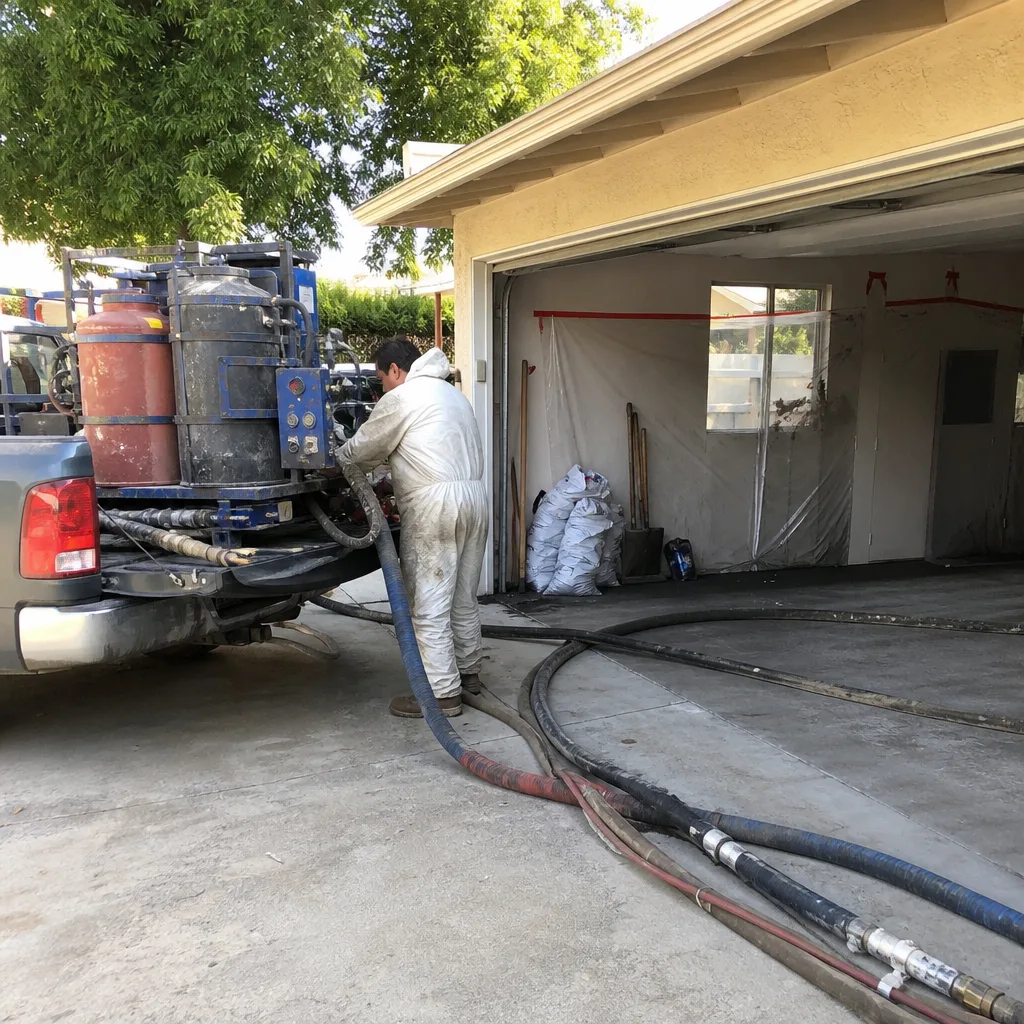
We’re an independent insulation contractor in Woodland Hills, not affiliated with Owens Corning, but we install and service their encapsulation products more than any other brand because the material holds up in Southern California’s weird mix of dry heat and coastal moisture better than most. Chase Whitaker, our owner, has pulled apart enough failed crawl spaces across the Warner Center corridor to know exactly where these systems break first, and it’s rarely where the homeowner thinks.
Which Owens Corning Models This Applies To
Owens Corning doesn’t sell crawl space encapsulation as a single SKU the way they sell pink fiberglass batts. The system is built from a few core components, and the failure point is usually one specific layer. The main product lines we work with are the Owens Corning CrawlSeal™ vapor barrier (available in 12-mil and 20-mil thicknesses), the Foamular® rigid foam board used on foundation walls, and the pink unfaced R-19 or R-30 fiberglass used in the rim joist bays. Most Woodland Hills homes built in the 1980s through early 2000s have a thinner 6-mil poly barrier that predates the current CrawlSeal spec, and that’s the piece that usually needs full replacement rather than repair.
The compatibility gotcha here is real: you can’t mix and match a 20-mil CrawlSeal floor liner with a 6-mil poly wall attachment and expect the seams to seal. The tapes and mastics Owens Corning specs for CrawlSeal are engineered for specific mil thicknesses. If you patch a 20-mil tear with off-the-shelf 6-mil poly tape from a hardware store, the adhesive fails within months because it can’t handle the temperature swings in a Woodland Hills crawl space, which range from the low 50s in January to over 90 in August. That’s the kind of detail that separates a redo from a one-and-done job.
For the foam board layer, we stock Owens Corning Foamular in 1-inch and 2-inch thicknesses, R-5 and R-10 respectively. The 2-inch board matters more than you’d think in Woodland Hills, because the foundation walls here absorb radiant heat from the surrounding soil all summer, and a 1-inch board simply doesn’t break the thermal bridge enough to stop condensation from forming on the interior surface. For rim joist insulation, we carry both the Owens Corning R-19 faced batts and, for tighter budgets, equivalent Johns Manville product. OEM versus aftermarket matters less for the batts than for the barrier and tape, where we strongly recommend staying with Owens Corning product because the chemistry of the tape adhesive is matched to the barrier film.
Signs Your Owens Corning Crawl Space Encapsulation Is Failing
- Humidity stays above 60% in the crawl space, even with a dehumidifier running. This usually means the vapor barrier has a tear or an unsealed seam somewhere along the floor or wall transition, and outside air is migrating in faster than the dehumidifier can pull moisture out. We’ve seen Woodland Hills homes where a dehumidifier ran 24/7 and still couldn’t keep up.
- You smell damp earth or mildew through the floor registers, especially after rain. Encapsulation that’s working should leave the crawl space smelling dry and neutral. A persistent musty odor means moisture is getting trapped between the barrier and an interior surface, or the barrier has pulled away from a foundation wall and exposed raw soil.
- Hardwood floors upstairs are cupping or buckling in a specific area. Wood expands when the subfloor underneath it absorbs moisture, and a failing encapsulation system can concentrate humidity directly under one room. If the cupping corresponds to a location above the crawl space access door or a plumbing penetration, that’s the likely failure point.
- Condensation beads on metal ductwork or copper pipes in the crawl space. This is a classic California symptom. In Woodland Hills, the cold water lines and AC ducts run through a space that should be dry, but when the barrier fails and humid air enters, that moisture condenses on anything cooler than the air temperature. Over time this rots insulation on the ducts and invites mold.
- You can see exposed dirt or a torn, wrinkled barrier when you look through the crawl space access. This is the most straightforward sign, but it’s the one people put off. It’s also important to check if the barrier has pulled away from the foundation wall piers or columns, because a barrier that’s no longer mechanically attached at those points is doing very little.
Replacement Cost & What’s Included
Installed encapsulation replacement in Woodland Hills runs $4,800 to $9,500 for most homes, though a small crawl space around 800 square feet can come in closer to $3,800, and a large or complex one with multiple zones, plumbing obstructions, or significant standing water issues can push past $12,000. The biggest cost drivers are crawl space square footage, the mil thickness of the barrier you choose, whether the foundation walls need new foam board, and how much of the existing material has to be removed and disposed of. You’ll get a written line-item price before any work starts, including the material, the labor, the old material haul-away, and any needed seam tape and mastic, so you’re never guessing at the final number.
Every encapsulation replacement we do includes a 365-day workmanship warranty in writing. If the barrier pulls loose, a seam opens, or the system isn’t performing, we come back and make it right, no charge. And if the repair ever fails within the warranty window, there’s a free second visit, period. That’s the standard we hold ourselves to, and it’s the same standard the Relay Visibility Guarantee enforces on every job in Woodland Hills.
DIY or Call Us?
Some things in a crawl space are safe to check yourself, and I want you to do this part: pull open the access door, shine a flashlight around, and look for standing water, exposed dirt, or a barrier that’s visibly torn or bunched up. Take photos and measure the square footage of exposed ground if you can. What you should not do is crawl in and start cutting and sealing 20-mil polyethylene with a utility knife and DIY tape, especially if the crawl space has fiberglass insulation hanging overhead, exposed wiring, or any sign of rodent activity. The physical risks of crawling through a tight, dusty, potentially moldy space are real, and the material risks of doing the job wrong are even more expensive than the labor you’d save. A bad seam job fails within a year, and you’ve now paid for the material twice. If you want to talk through what you’re seeing before deciding, call (559) 295-5362 and we’ll help you make sense of it.
FAQs
The barrier material itself is rated for 25+ years, but in real Southern California conditions, the weak points are the seams and the attachment points, which can start failing in 10 to 15 years if the original install wasn’t done correctly. The 20-mil CrawlSeal product holds up better than 12-mil in heat, and homes in Woodland Hills with significant diurnal temperature swings should expect to inspect the seam integrity every five years. Call (559) 295-5362 and we’ll tell you honestly whether your system looks like it has five years or fifteen left.
A small puncture can be repaired with the correct Owens Corning-compatible seam tape if the surrounding material is still in good condition and the barrier is still properly attached to the walls. But when the barrier is brittle, sun-damaged near the access point, or pulling away from the foundation in multiple places, repair is throwing money at a system that’s already past its useful life. We’ll tell you which situation you have, and we won’t sell you a full replacement if a targeted fix will hold.
Most Woodland Hills crawl spaces can be fully replaced in one day, with two days needed for larger homes or jobs that require old material removal, foam board replacement, and rim joist work. We give you a live arrival window before we show up, and you’ll get before-and-after photos of the space when the job is done. The crawl space is usable the same day we finish; there’s no curing time or waiting period.
We keep Owens Corning CrawlSeal barrier in 12-mil and 20-mil, Foamular board in 1-inch and 2-inch, and R-19 and R-30 fiberglass batts on our trucks and in our shop, which means we don’t have to order product and reschedule you for a week out. For barrier jobs, we also carry Reflectix as a supplemental option for specific radiant heat situations. If you need an exact price for your square footage, call (559) 295-5362 and we’ll give you a number over the phone before we even schedule the visit.
Written by Chase Whitaker, Owner, Laurel Attic Insulation Woodland Hills at Laurel Attic Insulation Woodland Hills, serving Woodland Hills and nearby areas.