
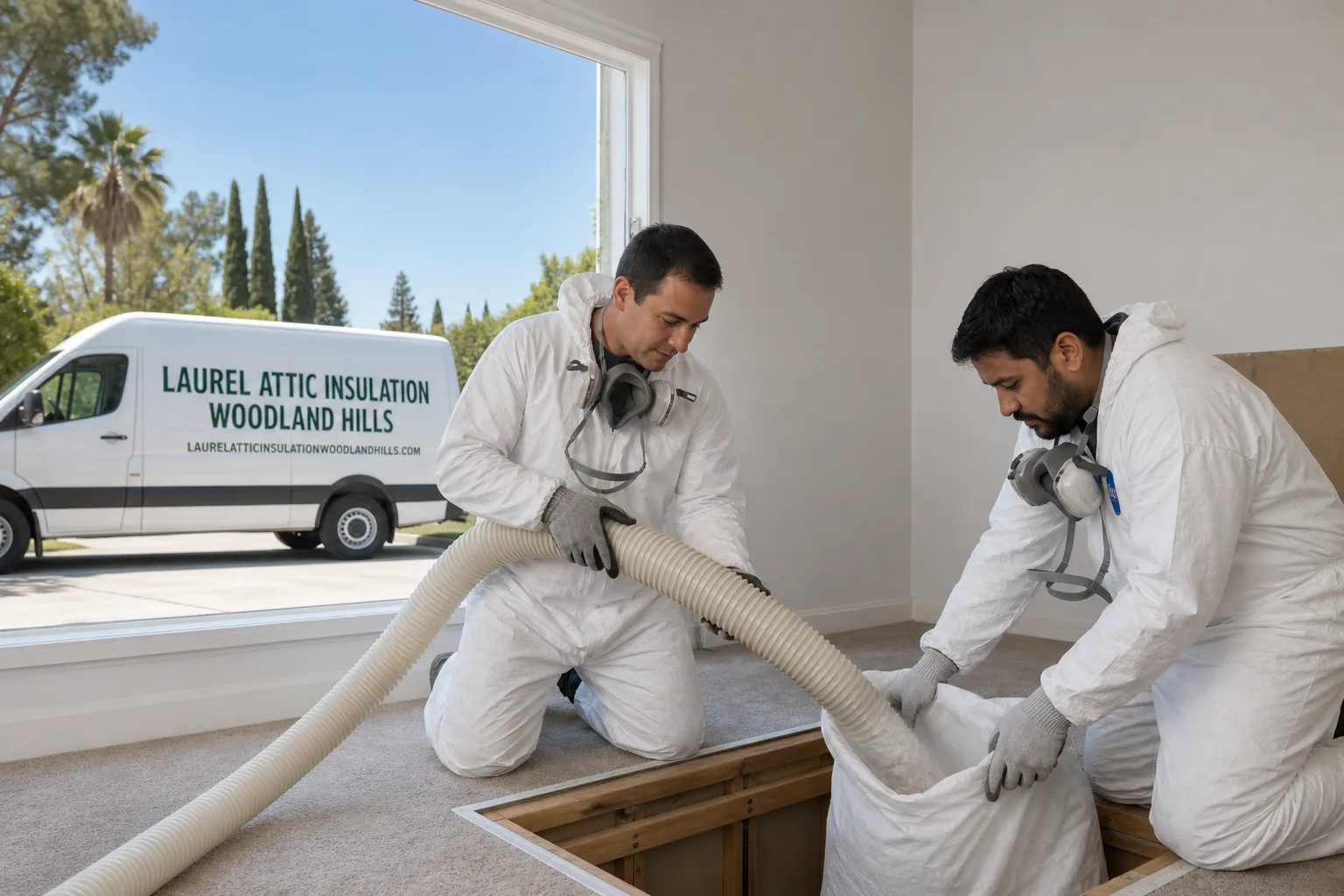
How Much Does Crawl Space Encapsulation & Vapor Barrier Cost in Woodland Hills?
Crawl space encapsulation in Woodland Hills typically runs $5,500 to $14,500 for a full system, with most homes landing between $7,800 and $11,200. A basic crawl space vapor barrier installation alone (12-mil polyethylene over the floor and up the walls) costs $2,400 to $4,800 depending on square footage and access. The final price depends on whether you insulate the foundation walls, seal the vents, add a dehumidifier, and repair any standing-water or drainage issues before the plastic goes down.
If you’re getting quotes that range wildly, that’s normal for this market – Woodland Hills has a mix of 1960s-era raised foundations, hillside crawl spaces with tight access, and newer builds. We’ll break down exactly what you’re paying for below.
Key Takeaways
- Cost range in Woodland Hills: $5,500 – $14,500 for full encapsulation; $2,400 – $4,800 for vapor barrier only.
- Labor runs 55 – 65% of the job – crawl space work is slow, confined, and physically demanding.
- Square footage is the biggest driver, but access (hillside, low clearance) can add 15 – 25%.
- Most encapsulation jobs in Woodland Hills take 2 – 4 days, not weeks.
- You’ll get a written price before work starts with Laurel Attic Insulation – no renegotiation at the door. Call (559) 295-5362 for a free estimate.
Crawl Space Encapsulation & Vapor Barrier Cost Breakdown (2026)
Here’s what a typical Woodland Hills encapsulation project actually costs line by line, based on a 1,200 – 1,600 square foot crawl space with standard 30 – 42 inch clearance:
| Component | Typical Cost Range | Notes |
|---|---|---|
| 12-mil vapor barrier (floor + walls) | $1,800 – $3,400 | Material + install. 12-mil is the standard; 20-mil adds $400 – $700. |
| Crawl space dehumidifier | $1,400 – $2,600 installed | Santa Fe or AprilAire units common; includes drain line to sump or exterior. |
| Foundation wall insulation (foam board or spray) | $1,100 – $2,800 | R-10 to R-19 depending on method; closed-cell spray costs more but handles moisture better. |
| Vent sealing / conditioning | $400 – $900 | Sealing foundation vents with rigid foam or block, making the space part of the home envelope. |
| Sump pump or drainage correction | $1,200 – $3,500 | Only if water pools after rain – common in mid-century tracts near the hills. |
| Floor joist insulation (optional) | $900 – $2,200 | Less common once you condition the space, but still requested in homes where ductwork runs through the crawl. |
| Labor & access charges | Included above, but add 15 – 25% if clearance is under 30 inches or access is hillside-tight | Low-clearance jobs take longer; crew fatigue and safety setup are real cost factors. |
That puts a full encapsulation – barrier, insulation, dehumidifier, vent sealing – at $5,500 to $14,500. If you’re quoted less than $4,000 for a “full encapsulation,” ask what’s included. Often that’s just a barrier laid on the floor with no wall coverage, no crawl space insulation, no humidity control. That’s not encapsulation; that’s a vapor barrier, and it won’t solve musty-smell problems on its own.
The single biggest swing factor is whether your crawl space has a moisture problem that needs to be handled first. In the hillside neighborhoods around Topanga Canyon Boulevard and Mulholland Drive, runoff after winter rains finds its way under homes – not always visible, but a moisture meter tells the story. If we have to install drainage or a sump, that’s a separate line item and we’ll explain it before any work starts.
What Affects Crawl Space Encapsulation & Vapor Barrier Pricing in Woodland Hills
Not every crawl space is the same, even on the same street. Here are the real factors that push a Woodland Hills quote up or down:
- Square footage and layout. A 900-square-foot crawl space under a single-story rancher in the flats is a straightforward job. A 2,400-square-foot space under a hillside split-level with multiple foundation steps is a different animal. More square footage means more material, more seam sealing, more time.
- Clearance height. If the space is 36 – 48 inches high, a crew can move and work efficiently. Under 30 inches, every step takes longer and safety protocols kick in. Some Woodland Hills homes built into slopes have crawl spaces as short as 18 – 22 inches in spots. These jobs cost 15 – 25% more per square foot.
- Existing moisture and drainage issues. If your crawl space has standing water after rain, efflorescence on the foundation walls, or visible fungal growth, those conditions have to be corrected before encapsulation. That might mean a French drain, a sump pump, or grading work outside. Expect $1,200 – $3,500 added to the job.
- Insulation scope. Encapsulating the space and insulating the foundation walls means you’re conditioning the crawl space – bringing it inside the home’s thermal envelope. Closed-cell spray foam costs more per board foot than rigid foam, but it air-seals and insulates in one pass. In a humid area like the San Fernando Valley, where crawl spaces run damp nine months of the year, spray foam holds up better than fiberglass batts, which can sag and hold moisture.
- Permitting and codes. Most encapsulation work in Woodland Hills doesn’t require a building permit if you’re not altering structure or electrical, but adding a dehumidifier circuit might require an electrical permit through LADBS if the home is in Los Angeles city limits. Woodland Hills is within the City of Los Angeles, so LADBS rules apply. A licensed contractor pulls permits when required – that’s part of the quote, not a surprise add-on.
- Access and site conditions. Hillside homes with narrow side yards, retaining walls, or tight gate access mean more labor to transport materials in and debris out. It’s not unusual for crews to hand-carry rolls of 12-mil liner up 40 feet of stairs on a Woodland Hills hillside. That labor shows up in the price.
Is Encapsulation Worth the Cost in Woodland Hills?
For most homes in this area, yes – and the math isn’t close. Woodland Hills sits in the San Fernando Valley, where winter rains saturate the soil for months and summer temperatures climb into the 90s and 100s. That combination means crawl spaces here are humid for most of the year. Humid crawl spaces push musty air up into the living space through floor gaps, rim joists, and around plumbing penetrations. That air carries whatever’s in the crawl space – dust, spores, allergens – into the rooms where you sleep and eat.
An encapsulated crawl space with a dehumidifier keeps relative humidity under 60%, which is the threshold where mold goes dormant. Homeowners we talk to in the neighborhood around El Camino Real and the 101 are usually dealing with one of three things: persistent musty smell on the first floor, humidity in the house that makes the AC work harder, or a pest issue where damp wood attracts termites and rodents. Encapsulation directly addresses all three.
As for energy savings, a proper encapsulation job typically cuts 10 – 15% off cooling costs in summer, because you’re no longer drawing damp outside air into the house through a vented crawl space. The savings alone won’t pay for the job in two years – it’s a long-game investment in air quality and home health, with energy savings as a bonus.
Vapor Barrier vs. Full Encapsulation: What’s the Difference and What Do They Cost?
These terms get used interchangeably, but they’re not the same thing, and the price difference is real:
- Vapor barrier only ($2,400 – $4,800 in Woodland Hills): A 12-mil or 20-mil polyethylene sheet laid over the dirt floor and run up the foundation walls and piers, with seams taped. It blocks ground moisture from rising into the crawl space, but vents stay open and the space still breathes outside air. This is a moisture-reduction strategy, not a conditioning strategy. It helps, but it won’t eliminate humidity on its own.
- Full encapsulation ($5,500 – $14,500 in Woodland Hills): Vapor barrier plus foundation wall insulation, sealed vents, a dehumidifier, and often a sump or drainage correction. The crawl space is now a semi-conditioned, sealed space. Air moving up into the house comes from inside the conditioned envelope, not from the dirt. This is the option that permanently changes the smell, humidity, and air quality of the home.
If your budget is tight and the goal is just to stop ground moisture from rising, a quality vapor barrier is the place to start. If you’ve got a musty smell in the house, allergy symptoms that worsen at home, or visible condensation on ducts in summer, you’re a candidate for full encapsulation. We’ll walk you through our crawl space encapsulation vapor barrier services honestly – sometimes the right call is to do the barrier now and add insulation and a dehumidifier next year. That’s a conversation, not a sales pitch.
How to Save on Crawl Space Encapsulation & Vapor Barrier
Encapsulation is a big-ticket item, and you should treat it like one. Here’s how Woodland Hills homeowners get the best value without cutting corners:
- Get three quotes, but compare scope, not just bottom line. One contractor’s $4,500 quote for a “vapor barrier” might be another contractor’s $8,000 job because the second one is doing wall coverage, seam sealing on piers, and taping every penetration. Ask for a written line-item scope. If a price looks too good, the scope is probably thinner.
- Target the off-season if you can. Crawl space companies in the LA area are busiest October through December, when the first rains make moisture problems obvious and people get quotes in batches. Late spring and summer (May – August) tend to be slower. You may not get a discount for scheduling then, but you’ll likely get faster scheduling and more contractor availability to compare quotes.
- Don’t skip the dehumidifier to save $1,500. In Woodland Hills specifically, the soil holds moisture year-round and the air in a sealed crawl space will hit 70 – 80% RH without mechanical dehumidification. You’d pay $7,000 to seal the space and still smell damp air six months later. The dehumidifier is not the place to economize.
- Ask about phasing. A reputable contractor will tell you if it’s reasonable to do the vapor barrier now and insulation plus dehumidifier later. Phasing spreads the cost across two projects, and the barrier alone starts delivering moisture reduction immediately. Just make sure the first phase is installed with the second in mind – wall liner should be left with enough material for future insulation, vents should be capped in a way that doesn’t prevent later sealing, and the dehumidifier drain can be roughed in.
- Use free estimates wisely. Laurel Attic Insulation Woodland Hills provides a free, written estimate – call (559) 295-5362 and we’ll send a technician to measure, test moisture levels, and give you a scope and price in writing before you commit to anything. No deposit, no pressure.
FAQs – Crawl Space Encapsulation & Vapor Barrier Cost
How much does crawl space encapsulation cost per square foot in Woodland Hills?
Expect $4.60 to $9.10 per square foot for full encapsulation in the Woodland Hills market, including barrier, wall insulation, vent sealing, and dehumidifier. Basic vapor barrier only runs $2.00 to $3.00 per square foot. Prices per square foot trend lower on larger jobs because setup and mobilization costs spread across more square footage. For an exact number on your home, call (559) 295-5362 for a free written estimate – no one gives accurate per-square-foot pricing over the phone without seeing the space.
Is it cheaper to do a vapor barrier myself?
Material for a 1,200-square-foot vapor barrier costs $600 – $900 at retail for 12-mil liner, tape, and fasteners – versus $2,400 – $4,800 for professional installation. But the material cost is the easy part. A proper installation means cutting the liner to fit around every pier, sealing every seam with the right tape, running liner up walls and piers, and taping around plumbing penetrations and duct supports. Most DIY jobs we see fail at the piers and penetrations, which is exactly where moisture finds a path around the barrier. Given that you’re working in a confined dirt space, often in tight clearance, the labor cost reflects real physical difficulty. If you’re set on DIY, a simple floor-only barrier is the only realistic scope – but it’s a partial solution in a climate like Woodland Hills.
How long does crawl space encapsulation take in Woodland Hills?
Most full encapsulation jobs take 2 – 4 days for a typical 1,200 – 1,600 square foot crawl space with normal clearance. Vapor barrier only is usually a 1 – 2 day job. Add a day if drainage or sump work is needed, and low-clearance or hillside access can stretch the schedule. Laurel Attic Insulation gives you a live arrival time and photo updates during the job through The Relay Standard – you’ll see the work as it happens, not at the end.
Does encapsulation require a permit in Woodland Hills?
Most vapor barrier and encapsulation work does not require a building permit from LADBS, provided the work doesn’t involve structural changes, gas line moves, or new electrical circuits. Adding a dedicated dehumidifier outlet can trigger an electrical permit if the panel is being tapped for a new circuit. A licensed contractor should identify permit requirements during the estimate and include that in the written price. Always confirm your contractor is pulling permits when required – it protects the value of the work and your insurance position.
Will encapsulation stop my crawl space from smelling musty?
Yes, in most Woodland Hills homes the musty smell resolves within 2 – 4 weeks of full encapsulation, and often faster once the dehumidifier is running. The smell comes from mold and bacteria metabolizing on damp wood and dirt surfaces. When you stop the moisture source – ground and vented outside air – and keep relative humidity under 60%, the biological activity stops and the odor fades. Homes with long-standing moisture problems may need surface treatment of joists or subfloor before encapsulation. During the estimate we use moisture meters and visual inspection to tell you whether your particular smell issue needs mechanical drying, sanitizing, or just encapsulation. Call (559) 295-5362 to schedule a free inspection.
Contact Laurel Attic Insulation Woodland Hills
If you’re researching crawl space encapsulation costs, you’ve probably got specific questions about your own home – and that’s exactly the right mindset. We’ll send a technician to your Woodland Hills home, measure the space, test the moisture levels, and give you a scope of work with a written price before anything starts. No vague ranges over the phone, no “we’ll figure it out when we get there” pricing. Call (559) 295-5362 today for a free estimate. You can also browse our services or read more about crawl space encapsulation and vapor barrier work in Woodland Hills to understand what a complete job includes.
Pricing reflects the Woodland Hills market as of 2026. Laurel Attic Insulation Woodland Hills offers free estimates – call (559) 295-5362.
Written by Chase Whitaker, Owner at Laurel Attic Insulation Woodland Hills, serving Woodland Hills and the surrounding San Fernando Valley since 2003.
What Our Customers Say
"Utility bill dropped the next month. Our summer electric bill was lower by a visible amount."
- Gary J."Quote in the app was clear on R-value and price."
- Doris L."Good job. The crew arrived about 30 minutes late, but the tracker showed it."
- Pete K.